
Breckenridge Ski Resort: A Complete Guide to Skiing and Snowboarding in Breckenridge, Colorado
There are plenty of reasons people come to Breckenridge, Colorado, but for many winter visitors, the mountain is where the vacation begins. Rising dramatically above the historic town, Breckenridge Ski Resort combines a large and varied ski area with something that many destination resorts struggle to provide: a real mountain town immediately below it. You can spend the morning skiing above treeline, return to town for lunch, walk along historic Main Street in the afternoon and finish the day with dinner or après-ski without feeling as though you’ve left the mountain behind.
That combination is a major part of what makes Breckenridge different. The resort is not an isolated ski area surrounded by parking lots and purpose-built lodging. Its five peaks are directly connected to the identity of the town, and the relationship between the mountain and Breckenridge’s historic downtown is one of the defining characteristics of the destination. GoBreck describes the resort as a mountain with five peaks and nearly 3,000 acres of terrain, while the resort itself emphasizes the distinct personality and terrain available across Peaks 6 through 10.
For a first-time visitor, however, that size can be a little intimidating. Breckenridge is a big mountain, and understanding the different peaks, base areas and types of terrain can make your vacation considerably easier. The good news is that you don’t need to know the entire mountain before you arrive. Once you understand how the resort is organized, it becomes much easier to decide where to start and how to build a day that matches your experience level.
What Makes Breckenridge Ski Resort Special?
Breckenridge Ski Resort is built across five distinct peaks—Peaks 6, 7, 8, 9 and 10—with nearly 3,000 acres of skiable terrain. The current mountain statistics list 2,908 acres, 187 trails, 35 lifts, a base elevation of 9,600 feet and a summit elevation of 12,998 feet at Peak 8. The resort also reports an average annual snowfall of 355 inches.
Those numbers are impressive, but they don’t fully explain the experience.
What makes Breckenridge particularly memorable is the variety within that terrain. One part of the mountain can offer broad groomed runs suitable for developing confidence, while another provides steep terrain and high-alpine skiing well above treeline. There are areas designed for beginners, long intermediate cruising, challenging advanced runs and expert terrain that demands considerably more experience.The mountain also has a strong sense of progression. A skier can visit Breckenridge as a beginner, spend time learning on easier terrain and gradually return in future seasons to explore more demanding parts of the mountain. That makes the resort appealing not only for experienced skiers looking for new terrain but also for families and first-time visitors who want a destination where different members of the group can ski at different levels.
Understanding Breckenridge’s Five Peaks
One of the first things to understand about Breckenridge Ski Resort is that “Breckenridge” isn’t really one single mountain in the traditional sense. The resort spans five peaks within Colorado’s Ten Mile Range, and each peak has a different character.
That distinction becomes important when you’re planning your ski day.
Peak 6 is associated with high-alpine terrain and above-treeline skiing. Peak 7 is known for wide-open intermediate terrain and a relatively straightforward experience for skiers who are comfortable on more advanced blue runs. Peak 8 is the central hub of the resort and offers a broad mix of terrain. Peak 9 is particularly important for beginners and families because of its learning terrain and proximity to town. Peak 10 is the place to look when you’re ready for more demanding expert-oriented terrain.
The five peaks aren’t simply different sections on a map.
They create different experiences.
Understanding that before your first day can save you a lot of unnecessary travel across the mountain.
Peak 8: The Heart of Breckenridge
Peak 8 is the central hub of Breckenridge Ski Resort and one of the most recognizable areas of the mountain. It provides access to a broad range of terrain and is also closely connected to the BreckConnect Gondola, which links the resort with the town. For first-time visitors, Peak 8 can be an excellent place to become familiar with the mountain because it combines skiing and riding opportunities with restaurants, services and access to other parts of the resort.
The terrain here ranges from beginner-friendly areas to more challenging skiing, making Peak 8 useful for groups whose members have different levels of experience.
It also has a strong social atmosphere.
After a few hours on the mountain, Peak 8 is one of the places where you can stop for food, take a break and regroup before deciding where to go next.
Peak 9: A Natural Starting Point for Beginners
Peak 9 has a particularly important role at Breckenridge because it offers terrain designed for people learning to ski or snowboard as well as skiers progressing beyond the beginner stage. The resort describes Peak 9 as a beginner-friendly area with wide-open trails and easy access from town, while its current mountain guide identifies ski school and learning terrain among the services available there.
For families traveling with children or adults taking their first lessons, that makes Peak 9 one of the most practical areas to understand before arriving.
You don’t want to spend your first morning trying to navigate advanced terrain simply because you started at the wrong base.
Peak 9 allows beginners to focus on the basics, build confidence and gradually progress without feeling as though they’re being thrown into the deep end.
Peak 7: Wide-Open Intermediate Terrain
Peak 7 has a different personality.
The resort describes it as a more understated base area and a good place to start for skiers and riders who are already comfortable on intermediate terrain. It provides access to groomed cruising and connections toward higher terrain.
For an intermediate skier, this can be an appealing combination.
You don’t necessarily need the intensity of the expert terrain, but you also don’t want to spend the entire day on beginner slopes.
Peak 7 gives confident intermediate skiers room to make longer runs, work on technique and explore terrain without constantly worrying about whether the next section is beyond their ability.
It can also be a convenient starting point for skiers who want to progress toward the high alpine as their confidence grows.
Peak 6: High-Alpine Adventure
Peak 6 is where Breckenridge’s high-alpine personality becomes especially apparent.
The resort describes Peak 6 as the gateway to its high alpine, with above-treeline terrain, hike-to areas and bowls.
This is not the part of the mountain where you want to begin your day if you’re still learning how to control your skis.
For experienced skiers and snowboarders, however, Peak 6 represents a different side of Breckenridge. The landscape becomes more exposed, the terrain more demanding and the feeling of being high in the Rockies much more pronounced.
Weather also matters considerably in this environment.
Above-treeline terrain can be affected by wind, visibility and changing conditions, so experienced skiers should always pay attention to current lift and terrain status before heading into the high alpine.
Peak 10: Expert Terrain
Peak 10 is the southernmost of Breckenridge’s five resort peaks and is known for its expert-oriented terrain. The resort’s current mountain guide describes Peak 10 as a destination for expert cruisers, while the winter trail map identifies it as expert-only terrain.
That makes Peak 10 fundamentally different from Peak 9.
If you’re traveling with a group that includes beginners and experts, it’s important to understand that everyone doesn’t need to ski the same peak all day. Breckenridge’s size makes it possible for different members of a group to choose terrain appropriate to their ability and meet later for lunch or après-ski.
That flexibility is one of the strengths of a large resort.
How Difficult Is Breckenridge Ski Resort?
Breckenridge offers terrain for every ability level, but its reputation for high-alpine skiing sometimes gives first-time visitors the impression that the entire mountain is difficult.
That’s not the case.
The current resort statistics classify approximately 11% of the terrain as beginner, 31% intermediate, 24% advanced and 34% expert.
That distribution tells a more useful story than simply calling Breckenridge an “expert mountain.”
There is plenty of accessible terrain, but there is also an enormous amount of challenging terrain for skiers who have developed the skills to use it.
The key is knowing your ability and choosing the right starting point.
A beginner should not feel pressured to ski the same terrain as an expert simply because everyone is visiting the same resort.
Skiing Breckenridge for the First Time
A first visit to Breckenridge is much easier when you resist the temptation to ski everywhere immediately.
Start by understanding the base area closest to where you’re staying and determine what terrain matches your ability. If you’re taking lessons, your instructor can help you understand where you should go as your skills develop. If you’re skiing independently, spend the first part of the day learning the mountain rather than chasing the longest or most difficult run.
This is particularly important at Breckenridge because the combination of elevation, terrain size and changing weather can make a day more demanding than it initially appears.
You don’t get extra points for being exhausted by noon.
The objective is to enjoy the mountain.
Breckenridge Ski and Snowboard Lessons
Lessons can make a significant difference, especially for beginners or visitors returning to skiing after a long break. Breckenridge offers ski and snowboard instruction for different experience levels, and the resort recommends booking lessons in advance. Its current site also promotes group lessons and indicates that booking in advance can provide access to package savings on rentals and lift tickets.
For families, lessons can also make the vacation easier for everyone.
Children can work with instructors while parents enjoy their own terrain, and beginners can build confidence without feeling as though they are slowing down more experienced members of the group.
Even intermediate skiers sometimes benefit from professional instruction because a lesson can help correct technique before bad habits become permanent.
The BreckConnect Gondola
The BreckConnect Gondola is one of the most useful pieces of infrastructure for visitors staying in Breckenridge.The gondola connects the town with the Peak 7 and Peak 8 base areas, and the resort states that the gondola is free for passengers. That means you can stay in town and reach the mountain without necessarily driving to a ski-area parking lot every morning.
For visitors staying near downtown, this can make a considerable difference.
You can have breakfast in town, walk or use local transportation to reach the gondola and then head toward the mountain.
At the end of the day, you can return to town and transition directly into dinner, shopping or après-ski.
The relationship between the gondola and downtown is one of the reasons Breckenridge feels more like a mountain town than a conventional ski resort.
Skiing From the Mountain Into Town
Another distinctive feature of Breckenridge is the ability to ski toward downtown using the Four O’Clock Run.
The resort currently identifies Four O’Clock as its longest run, extending approximately 3.5 miles, and describes the route as allowing skiers to descend from high on the mountain toward downtown Breckenridge.
For visitors staying in town, this creates an especially memorable end to the ski day.
Instead of finishing at a distant base area and then finding transportation back to your hotel, you can potentially ski toward town depending on the current operating conditions and your location.Of course, terrain status and snow conditions always determine whether particular runs are open, so visitors should check the current mountain report before planning their route.
High-Alpine Skiing at Breckenridge
One of Breckenridge’s defining characteristics is its high-alpine terrain.
The resort’s highest point reaches nearly 13,000 feet, and its high-alpine areas provide skiing and riding above treeline. The resort identifies this terrain as one of the defining aspects of the Breck experience.
For experienced skiers, this is one of the biggest attractions.
The views are expansive, the terrain can be demanding and the sensation of skiing high above the tree line is unlike skiing on lower mountain runs.
But elevation should never be treated casually.
Visitors who aren’t accustomed to high altitude may notice the difference even before skiing. Hydration, pacing and allowing your body time to adjust can make the experience considerably more comfortable. The resort itself recommends staying hydrated, limiting alcohol and allowing one to two days to acclimate to the elevation.
Breckenridge for Families
Breckenridge works particularly well for families because the resort provides terrain for different levels while the town below offers plenty of non-skiing activities.
A family doesn’t have to spend every hour together on the same run.
Children can take lessons, experienced parents can explore more demanding terrain and everyone can meet later for lunch or return to town.
The proximity of the mountain to downtown also gives families more flexibility than a remote ski area where every activity requires a car.
If someone in the group doesn’t ski at all, they can still enjoy restaurants, shopping, museums, winter activities and the historic character of Breckenridge while the skiers spend the day on the mountain.
That makes the destination more versatile than a trip built entirely around skiing.
Breckenridge for Advanced and Expert Skiers
Experienced skiers come to Breckenridge for very different reasons.The high alpine, bowls, steep terrain and extensive vertical range provide opportunities to challenge yourself over multiple days. The resort’s five peaks mean that you can change the character of your skiing without leaving the resort.
Peak 6 provides high-alpine terrain, Peak 10 concentrates on expert-oriented skiing, and other parts of the mountain provide advanced terrain and access toward the upper mountain.
That variety matters for a multi-day trip.
You don’t have to ski the same type of terrain every day.
One day might be dedicated to high-alpine skiing, another to long groomed runs and another to exploring terrain you’ve never tried before.
Snow Conditions and Breckenridge’s High Elevation
Breckenridge’s elevation is one of the characteristics that influences the resort’s skiing experience.
The base sits at 9,600 feet and the highest elevation reaches 12,998 feet. The resort reports average annual snowfall of approximately 355 inches.
But statistics shouldn’t be interpreted as a guarantee of conditions on a particular day.
Snow, wind, temperature and mountain operations change constantly.
That’s why the resort’s current terrain and lift-status tools are more useful than relying on an old description of what is normally open. The official mountain-status page provides current information about lift operations and terrain availability.
If you’re planning a ski day, check conditions before heading out.
That small step can save considerable time.
When Is the Best Time to Ski Breckenridge?
There isn’t one perfect answer.Early season can provide the excitement of the first days on snow, but terrain availability depends on snow conditions and mountain operations. Midwinter generally brings the classic Colorado ski experience, while spring can offer longer days, warmer temperatures and a different style of skiing.GoBreck specifically highlights spring skiing at Breckenridge and notes that the resort regularly operates into May when weather and conditions permit.
Spring also brings events, après-ski and the pond skim, making the mountain feel very different from January.
For travelers choosing dates based primarily on skiing, the best strategy is to consider both the experience you want and the conditions that typically accompany that part of the season.
Spring Skiing at Breckenridge
Spring deserves special attention because Breckenridge can continue operating well into the season.The resort’s high elevation and upper-mountain terrain can help maintain winter conditions while lower portions of the mountain begin to feel much more like spring. GoBreck highlights spring skiing, live music, après activities and the annual pond skim among the seasonal attractions.
This creates a different kind of ski vacation.
You can ski in the morning, spend the afternoon enjoying sunshine and then continue into an après-ski environment that feels more relaxed than the heart of winter.
For visitors who enjoy the social side of skiing as much as the skiing itself, spring can be an especially appealing time to visit.
Skiing and Snowboarding at Breckenridge
Breckenridge isn’t exclusively a destination for skiers.
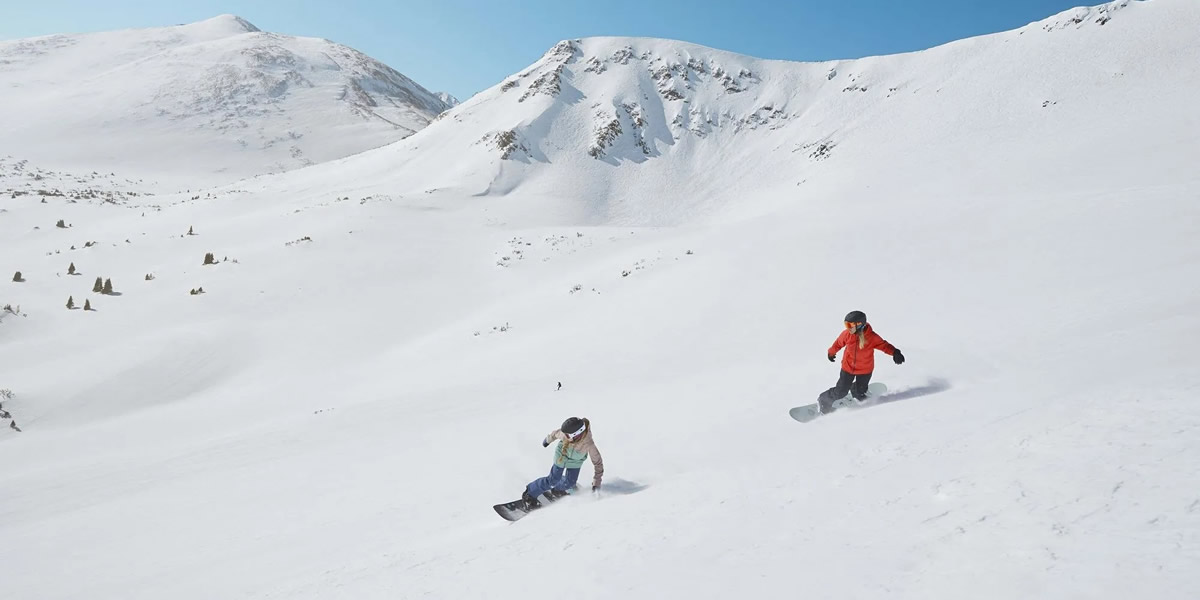
Snowboarders will find terrain across the mountain as well, including groomed runs, parks and high-alpine terrain.
The resort’s large footprint means snowboarders can build days around their preferred style just as skiers can.
Whether you enjoy carving groomed runs, exploring bowls, riding terrain parks or simply cruising with friends, the important thing is to choose terrain that matches your ability.
The mountain is big enough that there is no reason to force yourself onto terrain that isn’t enjoyable.
Terrain Parks at Breckenridge
Breckenridge also has terrain parks for riders who want a different type of challenge.
The resort currently lists three terrain parks in its mountain statistics.
Terrain parks require their own approach to safety and progression.
A visitor who is comfortable skiing blue or black runs isn’t automatically prepared for every park feature. Start with features appropriate to your ability and understand the park rules before progressing.For riders who enjoy jumps, rails and freestyle skiing or snowboarding, however, the parks add another dimension to a mountain that already offers a huge variety of terrain.
Après-Ski at Breckenridge
The ski day doesn’t have to end when the lifts close.Après-ski is a major part of the Breckenridge experience, and the town’s restaurants and bars make it easy to transition from mountain activities into the evening. One of the advantages of staying in Breckenridge itself is that you don’t have to drive to a separate entertainment district after skiing.
You can come down from the mountain, walk through town and choose a restaurant, bar or café based on your mood.
That makes the resort particularly appealing to groups where not everyone wants to spend the evening doing the same thing.
Dining on and Around the Mountain
Breckenridge has dining options both on the mountain and throughout the town.
On-mountain restaurants can be convenient when you want to maximize your ski time, while downtown restaurants provide a much wider range of choices once you’re finished skiing. The resort also offers dining as part of its Epic Mountain Rewards program for eligible pass holders, with current benefits including discounts at participating on-mountain food and beverage locations.
Because restaurant operations can vary by season and day, it’s worth checking current hours rather than relying on an old itinerary.
Ski Rentals and Equipment
You don’t need to bring all of your equipment to Breckenridge. The resort offers ski and snowboard rentals, and its current website encourages visitors to book rentals in advance, noting that advance online booking can provide savings. For beginners, renting is usually the easiest way to start because you can avoid investing in equipment before knowing whether you want to continue with the sport.
Experienced skiers may prefer their own equipment, but even they may choose to rent when traveling by air to avoid dealing with oversized luggage.
Either way, booking ahead can make the first morning considerably smoother.
Getting Around Breckenridge Without a Car
One of the strongest advantages of Breckenridge as a ski destination is that you don’t necessarily need a car once you arrive. The BreckConnect Gondola connects downtown with the mountain, and the town operates a free public transportation system serving the base areas. GoBreck specifically recommends the free bus system as one of the easiest ways to get around Breckenridge.
That can be particularly useful during winter when snow, traffic and parking can make driving less attractive.
Instead of getting into a car every morning, you can stay near town, use local transportation and concentrate on enjoying the mountain.
Getting to Breckenridge From Denver International Airport
For many visitors, the trip to Breckenridge begins at Denver International Airport.
The drive into the mountains is part of the Colorado experience, but after a long flight, handling luggage, winter roads and an unfamiliar mountain route isn’t necessarily how everyone wants to start a ski vacation.
Private transportation offers an alternative.
Great Divide Transportation provides private transportation from Denver International Airport to Breckenridge, allowing travelers to arrange their airport transfer before arriving in Colorado. This can be especially convenient for families, groups and travelers carrying skis, snowboards or other winter equipment.
Once you arrive in Breckenridge, the town’s walkability and local transportation make it possible to leave the vehicle behind for much of your stay.
Explore Breckenridge Transportation Services →
Breckenridge Ski Resort in Summer
Although skiing is the reason many people first discover Breckenridge Ski Resort, the mountain doesn’t disappear when winter ends. During summer, Peak 8 becomes the hub for Epic Discovery activities, while the BreckConnect Gondola provides access to the mountain and surrounding trails. GoBreck describes summer activities including scenic chairlift rides, hiking, climbing and other outdoor experiences. The resort’s current trail information also describes Peak 8 as the center of summer activities such as scenic chairlift rides, climbing walls, ropes courses, the Alpine Slide and Gold Runner Coaster.
That makes Breckenridge Ski Resort a year-round destination rather than simply a winter attraction.
The mountain changes character.
In winter, snow covers the terrain and the five peaks become a massive ski and snowboard playground.
In summer, trails, lifts and adventure activities take over.
Breckenridge Ski Resort Is More Than a Ski Mountain
The biggest mistake a first-time visitor can make is thinking of Breckenridge Ski Resort as simply a place where you buy a lift ticket and ski for eight hours.
The resort is part of a much larger experience.
The mountain is connected to a historic town. The town provides restaurants, lodging, shopping and entertainment. The gondola connects those two environments. The surrounding mountains provide hiking, biking and other outdoor activities outside the ski season.
That’s why a trip to Breckenridge can work even for groups where skiing isn’t everyone’s priority.
One person can ski all day.
Another can explore downtown.
Another can take a lesson.
And everyone can meet later for dinner.
Planning Your First Breckenridge Ski Trip
If you’re planning your first trip, start by choosing your lodging location, deciding whether you’ll need a rental car and determining what type of skiing or snowboarding experience you want.
Then look at the resort map.
Identify the base area closest to your accommodation and understand which peak makes sense for your ability.
If you’re a beginner, don’t worry about exploring all five peaks on your first day.
If you’re an experienced skier, give yourself several days if possible because Breckenridge’s size makes it difficult to experience everything in a single day.
And don’t forget to leave some time for the town.
That’s the part that makes Breckenridge different from many other ski destinations.
Frequently Asked Questions About Breckenridge Ski Resort
How many peaks does Breckenridge Ski Resort have?
Breckenridge Ski Resort has five peaks: Peak 6, Peak 7, Peak 8, Peak 9 and Peak 10. Together they provide nearly 3,000 acres of skiable terrain.
How many trails does Breckenridge have?
The resort currently lists 187 trails across its five peaks.
What is the elevation of Breckenridge Ski Resort?
The base elevation is 9,600 feet and the highest elevation listed by the resort is 12,998 feet at Peak 8.
Is Breckenridge good for beginner skiers?
Yes. Peak 9 is particularly well suited to beginners and families learning to ski or snowboard, and the resort offers lessons for different ability levels.
Is Breckenridge good for advanced skiers?
Yes. Breckenridge has substantial advanced and expert terrain, including high-alpine terrain across its upper mountain and expert-oriented terrain on Peak 10.
Is the Breckenridge Gondola free?
Yes. The BreckConnect Gondola is free for passengers and connects the town with the Peak 7 and Peak 8 base areas.
Can you ski from Breckenridge Ski Resort into town?
Yes, when the relevant terrain is open and conditions permit. The resort identifies Four O’Clock as a long run that can take skiers toward downtown Breckenridge.
Is Breckenridge Ski Resort good for families?
Yes. The combination of beginner terrain, ski school, different ability levels and the proximity of the mountain to downtown makes Breckenridge particularly convenient for families.
Does Breckenridge Ski Resort have summer activities?
Yes. During summer, Peak 8 hosts Epic Discovery activities, while the gondola and lifts provide access to hiking, biking and scenic mountain experiences, depending on the operating schedule.
How should I get from Denver Airport to Breckenridge Ski Resort?
Travelers can rent a vehicle, use shared or scheduled transportation, or arrange private transportation. For travelers who want a direct airport-to-resort transfer, Great Divide Transportation offers private transportation to Breckenridge.
Experience Breckenridge From the Mountain
Breckenridge Ski Resort is impressive because of its size, elevation and variety, but those numbers only tell part of the story.The real attraction is the relationship between the mountain and the town.You can start your morning riding the gondola from downtown, spend several hours skiing above treeline, take a long run toward town, walk along Main Street and finish the day with dinner surrounded by the historic character of Breckenridge.
For beginners, the mountain provides room to learn.
For intermediate skiers, it provides enough terrain to keep progressing.
For advanced and expert skiers, the high alpine and upper mountain offer challenges that can take days to explore.
And for non-skiers, the mountain is still part of the scenery and the broader Breckenridge experience.
That is ultimately what makes Breckenridge Ski Resort special: it isn’t just a ski resort sitting next to a town. The mountain and the town are part of the same destination.