
Biking in Breckenridge, Colorado: A Complete Guide to Cycling in the Rockies
Biking in Breckenridge is one of the best ways to experience the Colorado Rockies from a completely different perspective. Once the snow begins to disappear from the lower elevations and the mountain trails become accessible, Breckenridge turns into a destination for road cyclists, mountain bikers, families looking for an easy ride and visitors who simply want to explore the scenery on two wheels. The combination of paved recreational paths, mountain roads, dirt routes and extensive singletrack gives cyclists an unusual amount of choice, whether you’re looking for a relaxed afternoon ride or a much more demanding mountain adventure.
What makes biking in Breckenridge particularly interesting is that you don’t have to be an experienced cyclist to enjoy it. The area offers routes for different abilities, and some of the easiest riding can be done close to town. The Blue River Recreation Path, for example, provides a paved route through Breckenridge and connects with the larger Summit County recreation-path system. More experienced riders can take on mountain roads such as Boreas Pass or venture onto mountain-bike trails where elevation gain, technical terrain and descending become a much larger part of the experience.
And then there is another option that has become increasingly popular: the e-bike. Electric bicycles can make it easier to cover more ground and deal with some of Breckenridge’s elevation, although riders still need to understand where different classes of e-bikes are permitted and how to share the trail responsibly.
The result is a biking destination where you can spend a morning riding beside the Blue River, explore Breckenridge’s historic streets in the afternoon and still have plenty of options for a more ambitious ride during another day of your vacation.
Why Breckenridge Is Such a Great Biking Destination
Breckenridge has many of the characteristics cyclists look for in a mountain destination: dramatic scenery, an extensive trail network, paved recreational paths, mountain roads and access to routes that connect the town with surrounding communities. The town has also developed a strong cycling culture. Breckenridge is designated as a Gold-level Bicycle Friendly Community by the League of American Bicyclists, reflecting efforts to improve bicycling infrastructure and educate both cyclists and motorists about sharing the road.
But the real attraction is the landscape.
You are riding beneath the Tenmile Range, through evergreen forests, alongside the Blue River and, depending on the route, toward higher mountain terrain where the scenery becomes increasingly expansive.
That means the ride itself becomes part of the vacation.
You’re not simply trying to get from one point to another.
You’re exploring the mountains.
When Is the Best Time to Go Biking in Breckenridge?
The most popular biking period is during the warmer months, particularly summer and early fall.
Summer generally provides the broadest range of cycling opportunities, with paved recreational paths, road routes and mountain-bike trails offering different ways to explore the area. Fall adds another dimension because the surrounding aspen forests begin changing color, creating an especially scenic environment for cyclists. GoBreck specifically describes summer and fall as strong seasons for mountain biking and notes that conditions at higher elevations can affect when certain trails become accessible.
The exact beginning and end of the biking season depend on elevation and weather.
A trail at lower elevation may be rideable while higher terrain is still affected by snow or mud. For that reason, checking current trail conditions before heading out is much more useful than relying on a fixed opening date.
This is especially important if your trip is planned for early summer or late fall.
Colorado mountain weather doesn’t always follow the calendar.
Road Biking in Breckenridge
Road biking gives you a completely different way to experience the mountains.
Instead of navigating technical singletrack, road cyclists can follow paved routes through Summit County and connect Breckenridge with neighboring communities. The Summit County Recreation Path is one of the most accessible options, providing a paved network that extends beyond Breckenridge and gives cyclists the opportunity to explore a much larger portion of the region.
The beauty of this type of riding is the combination of distance and scenery.
You can maintain a steady pace while the mountains remain part of the landscape throughout the ride. For visitors who aren’t interested in technical mountain biking, this can be the perfect introduction to cycling in Breckenridge.
The recreation-path system also makes it easier to build a ride around your own ability.
You don’t necessarily have to commit to an enormous mountain loop. You can ride for a while, stop for photographs or lunch and return to Breckenridge when you’re ready.
The Blue River Recreation Path
If you’re looking for a relaxed ride, particularly if you’re traveling with family, the Blue River Recreation Path is one of the most accessible places to start. The paved path follows the Blue River through Breckenridge and connects with the larger Summit County recreation-path network. It is shared by cyclists, runners, walkers and other recreational users, making it much more of a multi-use pathway than a dedicated high-speed cycling route.
The scenery is the real attraction.
The route passes beneath the Tenmile Range, giving riders a chance to enjoy mountain views without having to immediately tackle difficult terrain.
For families, this can be a particularly enjoyable option because the ride can be approached at a relaxed pace. You can stop, take photographs and simply enjoy being outside rather than worrying about completing a demanding route.
It is also a useful starting point for visitors who are still adjusting to Breckenridge’s elevation.
Biking Around Downtown Breckenridge
You don’t have to leave town to incorporate cycling into your Breckenridge vacation.
Downtown Breckenridge has bike lanes on major roads and provides places to lock bicycles, while local bike shops offer rentals, equipment and guidance for visitors who don’t bring their own bikes.
This makes it easy to combine cycling with other activities.
You might ride into downtown in the morning, explore Main Street on foot, have lunch and then continue on a recreational path later in the afternoon.
E-bikes are also available from rental businesses around town, providing another option for visitors who want to cover more ground without committing to a traditional high-effort cycling experience.
The important thing is to remember that a bike doesn’t have to be the main event.
Sometimes it’s simply the most enjoyable way to move around the town.
Riding Boreas Pass
For cyclists looking for something considerably more demanding, Boreas Pass Road is one of the classic mountain rides associated with Breckenridge.The road climbs out of town toward Boreas Pass and provides expansive views of the surrounding Tenmile and Mosquito Ranges. GoBreck specifically recommends the route for riders looking to challenge themselves physically while enjoying the scenery.
This is not the same experience as cruising along the Blue River Recreation Path.
Boreas Pass requires considerably more effort, and elevation becomes an important part of the challenge. The reward is that the climb takes you into increasingly dramatic mountain scenery.
For experienced cyclists, this is exactly the type of route that makes a Breckenridge cycling vacation memorable.
But don’t underestimate it simply because it is a road.
Mountain roads can be physically demanding, and riders should consider weather, elevation, traffic and their own fitness before committing to the climb.
Mountain Biking in Breckenridge
Mountain biking is where Breckenridge becomes an entirely different kind of cycling destination. The area has hundreds of miles of trails in and around town, with options ranging from relatively gentle routes to technical terrain. GoBreck’s mountain-biking resources separate routes into different difficulty levels and include options for beginners, families and experienced riders.
This variety is one of the strongest reasons to visit Breckenridge with a mountain bike.
A beginner can start with a relatively approachable trail and develop confidence before moving into more challenging terrain. Experienced riders can look for technical descents, climbs and singletrack that demand significantly more skill.
The scenery remains spectacular at every level.
You don’t need to ride the hardest trail in Breckenridge to experience the mountains.
In fact, for many visitors, a moderate ride with time to appreciate the scenery can be more enjoyable than spending the entire day concentrating on technical terrain.
Easy Mountain Biking for Beginners and Families
If you’re new to mountain biking, Breckenridge provides opportunities to learn without immediately throwing yourself into difficult terrain.The local biking resources include easier routes designed for riders who are beginning to explore dirt trails and for families looking for accessible outdoor activities.
One of the advantages of starting with an easier route is that you can concentrate on the fundamentals.
You can become comfortable with the bike, learn how the terrain affects handling and figure out how your body responds to riding at elevation.
That matters because mountain biking is not simply road cycling on dirt.
Loose surfaces, roots, rocks, changes in grade and descents require different techniques.
For families, the goal should be even simpler: choose a route where everyone can enjoy the experience.
A successful family ride isn’t measured by mileage.
It’s measured by whether everyone wants to go again tomorrow.
Moderate Mountain Biking in Breckenridge
Once you’ve gained confidence, moderate mountain-bike routes open up a much larger portion of the landscape.GoBreck highlights routes such as the Galena Ditch to Colorado Trail and Gold Run Road among the more challenging options, while its broader mountain-bike guide includes routes with significant elevation gain and more technical characteristics.
These rides require more preparation than an easy recreational-path outing.
Distance, elevation gain and terrain can dramatically change the amount of effort required. A route that appears manageable when viewed on a map may feel very different once you’re climbing at high elevation.
That is why checking the route profile and current conditions before riding is important.
And if you’re unfamiliar with Breckenridge, asking a local bike shop or guide for advice can be extremely valuable.
E-Biking in Breckenridge
E-bikes have added another dimension to cycling in Breckenridge.
They allow riders to travel farther and make climbs more manageable, which can be particularly attractive in a high-elevation mountain town. They are also a practical option for visitors who want to explore the area without committing to the physical demands of a traditional bicycle.
But an e-bike is still a bicycle, and riders need to understand the local rules.
Current Summit County guidance allows Class 1 e-bikes on the Recpath where regular bicycles are permitted, while Class 2, Class 3 and unclassified e-bikes remain prohibited on the Recpath. E-bikes are also not permitted on natural-surface trails designated as non-motorized.
Those distinctions matter.
Before renting an e-bike, make sure you know what class it is and where you are legally allowed to ride it.
A few minutes of preparation can prevent a frustrating situation once you’re on the trail.
E-Bike Etiquette Matters
Because e-bikes can travel efficiently and carry additional momentum, riders should be particularly conscious of other trail users. GoBreck recommends staying on designated routes, yielding appropriately, signaling before passing, keeping to the right side of the recreation path and wearing a helmet. Riders should also move completely off the path when stopping for photographs or taking a break.
These rules aren’t complicated.
They simply recognize that the recreation paths are shared spaces.
You may be moving quickly on an e-bike while someone ahead of you is walking with a child or walking a dog.
Slow down.
Signal.
Give people room.
The goal is for everyone to enjoy the trail.
Fat Biking in Breckenridge
Cycling doesn’t completely disappear when summer ends.
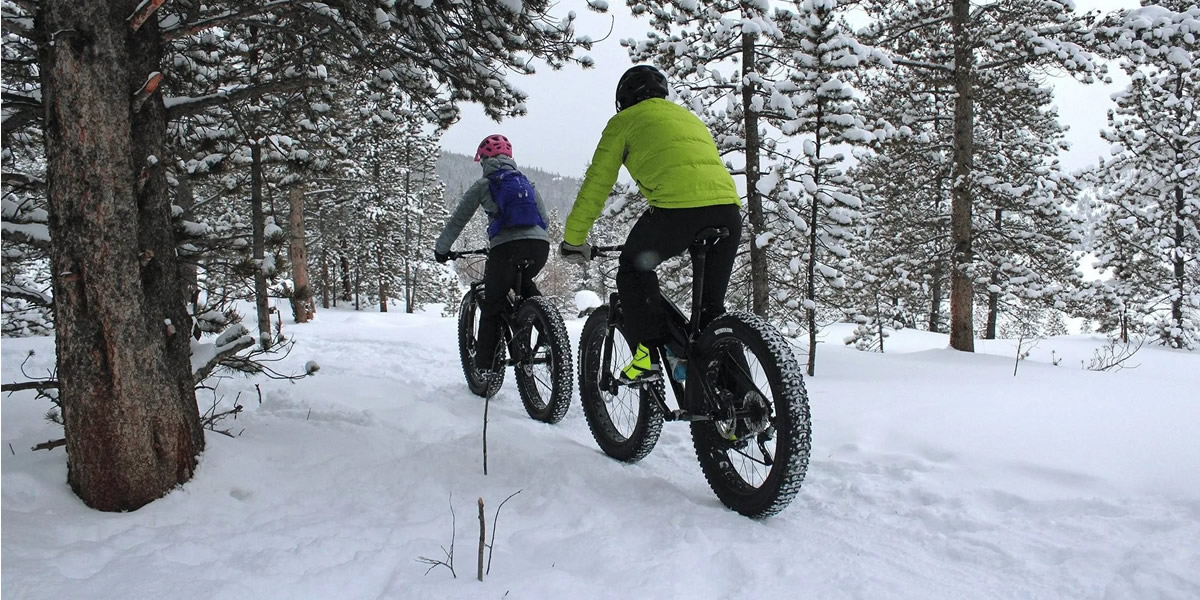
During winter, fat biking provides another way to explore Breckenridge’s snowy landscape. These bicycles use oversized tires designed to provide better flotation and traction on snow, allowing riders to explore routes that would be difficult or impossible on a conventional bicycle. Breckenridge’s winter fat-biking options include riding on certain recreational paths and groomed terrain, including routes at the Gold Run Nordic Center. Visitors can also rent equipment and take guided fat-bike tours.
Fat biking is particularly interesting because it gives visitors an outdoor winter experience without requiring skis or a snowboard.
You still get the snow-covered forests and mountain scenery.
You’re just experiencing them from two wheels.
Biking in Breckenridge During Fall
Fall deserves special attention because cycling and autumn scenery work remarkably well together.The cooler temperatures make longer rides more comfortable for many cyclists, while the changing aspens transform the surrounding landscape. Mountain biking can be particularly rewarding during this period because trails that were green during summer suddenly become surrounded by gold.
Road cyclists also benefit from the scenery.
A ride along a paved path or mountain road can become a moving leaf-peeping experience, allowing you to see changing colors at different elevations rather than staying in one location.
As with hiking, however, the timing of fall foliage varies.
If seeing the aspens is one of your main goals, check current local conditions before planning your ride.
Biking and Breckenridge’s High Elevation
One of the biggest differences between cycling in Breckenridge and cycling at lower elevations is the altitude.
The town sits at more than 9,000 feet above sea level, and routes can climb considerably higher. That means even cyclists who are in excellent physical condition may find themselves working harder than expected.
The mistake is to assume that fitness at sea level automatically translates to mountain performance.
It doesn’t.
Your breathing may feel different, climbs may take longer and recovery may require more time.
The best strategy is to start conservatively, particularly during your first day or two in town.
There’s no reason to turn the first ride of your vacation into a test of endurance.
Let your body adjust.
Then ride farther.
What Should You Bring on a Breckenridge Bike Ride?
Your equipment depends heavily on the type of cycling you’re doing.
A casual ride along the recreation path requires a very different setup from a mountain-bike adventure or a long road climb.Regardless of the type of ride, however, you should be prepared for changing mountain conditions. Layers are important because temperatures can change significantly during the day, particularly as you gain elevation.
Sun protection is also important.
At high elevation, the sun can feel stronger than visitors expect, even when the air temperature is relatively comfortable.
Bring water, appropriate clothing and a helmet, and make sure your bike is properly maintained before leaving.
If you’re renting, this is one of the advantages of using a reputable local bike shop: staff can help match the equipment to the type of riding you’re planning.
Mountain Weather Can Change Quickly
Colorado’s mountain weather should never be treated casually.
A morning can begin under clear skies and become considerably different later in the day. Higher elevations can also experience conditions that are different from those in downtown Breckenridge.
This matters particularly for cyclists because you’re often traveling farther from town than you realize.
A mechanical problem several miles from your starting point is very different from a mechanical problem two blocks from your hotel.
Before leaving, check the weather and trail conditions, understand your route and make sure someone knows where you’re going if you’re heading into more remote terrain.
And if conditions deteriorate, don’t hesitate to change your plans.
The mountains will still be there tomorrow.
Bike Rentals and Local Knowledge
One of the easiest ways to get started if you don’t bring your own bike is to rent locally.Breckenridge has bike shops that provide rentals, service and equipment, and some also offer guided tours or instruction. GoBreck specifically points visitors toward local bike shops and guides as resources for choosing equipment and routes.
This local knowledge is valuable.
A shop employee can tell you which routes are appropriate for your experience level, what the current conditions are like and which type of bicycle makes the most sense.
That’s particularly important if you’re visiting early or late in the season when trail conditions can vary considerably.
Instead of asking only, “What’s the best bike?”
Ask:
“What bike and route make sense for what I want to do today?”
You’ll probably get a much better answer.
Guided Bike Tours in Breckenridge
A guided ride can be an excellent option for visitors who don’t know the area or who want to improve their skills.Local guides can help with route selection, mountain-bike technique and navigating terrain that might otherwise be intimidating.GoBreck highlights guided mountain-bike instruction and tours, including beginner and intermediate options. Breckenridge Ski Resort also offers mountain-bike instruction during the appropriate season.
For someone new to mountain biking, a lesson can be particularly valuable.
You learn how to handle the bike before you’re dealing with more complicated terrain.
And because a guide knows the local trails, you can spend less time worrying about where you’re going and more time enjoying the ride.
Responsible Biking in Breckenridge
Breckenridge’s trails are part of a larger natural environment that receives significant recreational use throughout the year.
That makes responsible riding important.
Stay on designated trails, respect closures, yield appropriately to other users and avoid creating new routes around obstacles or muddy sections.
GoBreck promotes the Leave No Trace principles as part of responsible outdoor recreation, including planning ahead, staying on established trails, properly disposing of waste, respecting wildlife and leaving natural features undisturbed.
This isn’t just about protecting the landscape.
It’s also about protecting access.
The better visitors take care of the trails, the easier it is for future cyclists to continue enjoying them.
Exploring Breckenridge by Bike Without a Car
One of the most appealing aspects of cycling in Breckenridge is the possibility of combining biking with a relatively car-free vacation.Downtown is compact, recreational paths connect different areas and cycling can provide an efficient way to explore without driving everywhere. GoBreck specifically promotes car-free exploration in Breckenridge and highlights the accessibility of many areas by foot and bicycle.
For visitors staying near downtown, this can make a significant difference.
You can walk to breakfast, ride along the Blue River, return to town for lunch and spend the afternoon exploring Main Street.
Instead of treating transportation as something separate from the vacation, the bike becomes part of the experience.
Getting Your Bike to Breckenridge
If you’re traveling from outside Colorado, transportation becomes an important consideration.
Bringing your own bike can be worthwhile if you’re an experienced cyclist who already has equipment configured specifically for your riding style. But traveling with a bicycle adds another layer of logistics, particularly when flying into Denver International Airport.
You’ll need to consider luggage, bike cases, ground transportation and how you’re going to get from the airport into the mountains.
For visitors who don’t want to manage all of that, renting locally can be considerably simpler.
Another option is private transportation that can accommodate your group and equipment.
Great Divide Transportation provides private transportation between Denver International Airport and Breckenridge, making it possible to arrange your mountain transfer without having to navigate unfamiliar roads immediately after a flight.
For cyclists carrying luggage or bike equipment, arranging transportation in advance can make the beginning of the trip much easier.
Planning your trip from Denver International Airport to Breckenridge?
Explore Breckenridge Transportation →
How to Build a Breckenridge Cycling Vacation
The best cycling trip doesn’t have to involve riding every day. In fact, alternating different types of activities can make the vacation much more enjoyable. You could spend one day exploring the Blue River Recreation Path, another day tackling a mountain-bike route and another day simply walking around town.
If you’re visiting during fall, dedicate some time to scenic rides through the changing aspens.
If you’re visiting in winter, consider fat biking as an alternative to skiing.
And if you’re traveling with people who don’t cycle, plan activities that allow everyone to meet up later.
That’s one of Breckenridge’s biggest strengths.
You can build a vacation around cycling without making every hour of the trip about cycling.
Frequently Asked Questions About Biking in Breckenridge
Is Breckenridge good for biking?
Yes. Breckenridge offers paved recreation paths, road cycling routes, mountain-bike trails and winter fat-biking opportunities, making it suitable for a wide range of riders.
Can beginners bike in Breckenridge?
Absolutely. The area has accessible paved paths and easier biking routes suitable for beginners and families. More challenging mountain-bike trails are available as riders gain experience.
Where is the best place to bike in Breckenridge?
It depends on your riding style. The Blue River Recreation Path is a good option for relaxed riding, while Boreas Pass provides a more demanding road ride. Mountain bikers have access to a much larger network of dirt and singletrack trails.
Can I ride an e-bike in Breckenridge?
Yes, but e-bike regulations vary by class and location. Summit County currently allows Class 1 e-bikes on the Recpath where regular bicycles are permitted, while Class 2, Class 3 and unclassified e-bikes are prohibited there.
Can you mountain bike in Breckenridge?
Yes. Breckenridge has an extensive mountain-bike trail network with options ranging from beginner-friendly routes to technical terrain.
Is Breckenridge good for family biking?
Yes. The Blue River Recreation Path and easier biking routes provide opportunities for families to explore the area at a relaxed pace.
Can you bike in Breckenridge during winter?
Yes. Fat biking has become a popular winter activity, and certain groomed routes and recreational paths can be used with appropriate equipment and conditions.
When is the best time to bike in Breckenridge?
Summer and early fall provide some of the broadest cycling opportunities. Fall is particularly attractive for riders who want to combine cycling with autumn foliage, while winter offers a separate fat-biking experience.
Is biking difficult because of Breckenridge’s elevation?
The elevation can make cycling more physically demanding, particularly for visitors coming from lower elevations. Riders should allow time to adjust and choose routes appropriate for their fitness and experience.
Can I bike in Breckenridge without a car?
Yes. Downtown Breckenridge and the surrounding recreation-path network make it possible to incorporate cycling into a car-free vacation, depending on where you’re staying and which routes you want to ride.
Discover Breckenridge on Two Wheels
Biking gives you a different relationship with Breckenridge.
When you’re driving, the scenery passes by the windows. When you’re hiking, you’re moving at walking pace. On a bicycle, you find a middle ground where you can cover meaningful distances while still feeling connected to the landscape.
You can hear the river.
You can stop whenever a mountain view catches your attention.
You can ride through a stand of aspens and continue toward another part of the valley without spending the day behind the wheel.
That’s what makes biking in Breckenridge such a memorable part of a Colorado vacation.
Whether you choose an easy ride along the Blue River, a challenging climb up Boreas Pass, a mountain-bike adventure through the forest or a winter fat-bike excursion through the snow, the experience is ultimately about the same thing:
getting outside and seeing Breckenridge from a different perspective.