Discover the Wild Side of Vail
Vail is famous for its enormous ski area, perfectly groomed trails, legendary Back Bowls, and Blue Sky Basin, but there is another side of the destination that begins where the maintained resort terrain ends. Beyond Vail Mountain’s boundaries lies a vast winter landscape of forests, ridgelines, open bowls, and undeveloped snow where skiers and snowboarders can experience Colorado in a much more remote and demanding way.
This is the world of backcountry skiing in Vail.
Unlike resort skiing, backcountry skiing takes place outside the controlled and maintained ski area. There are no groomed runs, no lift operators waiting at the top, and no ski patrol regularly monitoring the terrain. Snow conditions can change dramatically from one slope to another, and hazards such as avalanches, hidden obstacles, unstable snow, cliffs, tree wells, and difficult navigation become part of the experience.
That difference is precisely what attracts experienced skiers and snowboarders. Backcountry skiing offers a sense of exploration that is difficult to reproduce inside a conventional ski resort. You earn your turns, travel through quieter terrain, and experience the mountains without the crowds and infrastructure found inside the resort.
But the freedom comes with responsibility. The backcountry surrounding Vail is beautiful, but it is not inherently safe simply because it is close to a major ski resort. Anyone considering an excursion beyond the resort boundary should have appropriate training, equipment, knowledge of avalanche conditions, and a realistic understanding of their own abilities. Vail Mountain itself warns that terrain beyond the resort boundary is not patrolled or maintained and that backcountry travel can be life-threatening.
For visitors who are properly prepared, or who choose to explore with an experienced guide, the Vail backcountry can become one of the most memorable experiences of a Colorado winter vacation.
What Is Backcountry Skiing?
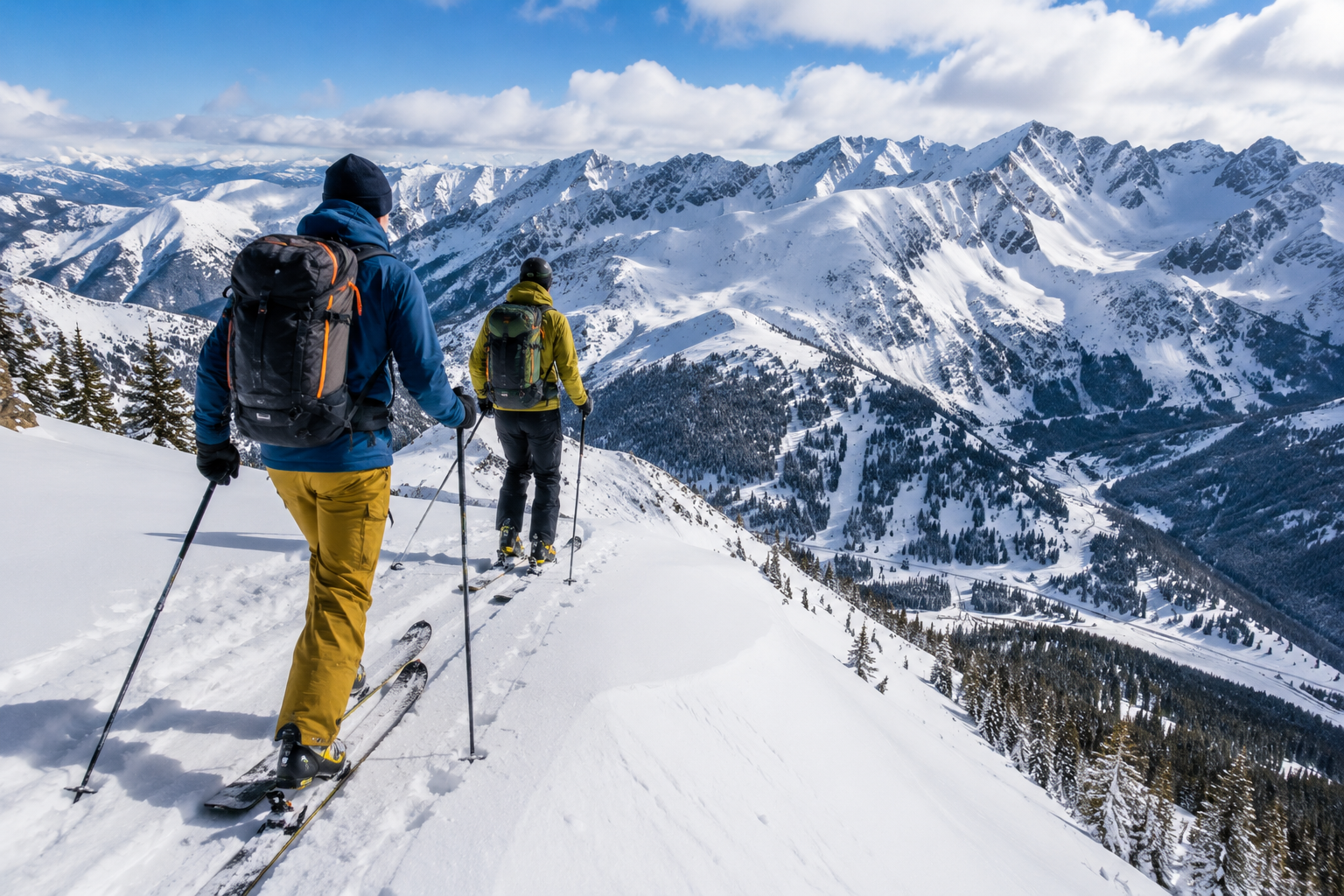
Backcountry skiing refers to skiing or snowboarding in natural, undeveloped terrain outside a managed ski resort. Rather than following marked trails and relying on lifts, skiers travel through the mountains under their own power and make their own decisions about route selection, terrain, weather, snowpack, and safety.The experience can take many forms. Some skiers use alpine touring skis equipped with climbing skins to ascend a mountain before transitioning their equipment for the descent. Snowboarders may use splitboards that separate into two sections for climbing and reconnect for the ride down. Telemark skiers use free-heel equipment designed for both uphill travel and downhill turns.
The equipment may differ, but the fundamental idea is the same: you are responsible for getting yourself into and out of the terrain.
That changes the entire character of the experience.
Inside a ski resort, the mountain has already been evaluated and managed for you to a significant degree. Trails are marked, hazards are identified, snow is groomed in many areas, and ski patrol is available within the resort’s operating system. In the backcountry, those layers of protection largely disappear.
You become responsible for understanding the mountain.
Backcountry Skiing vs. Resort Skiing
The difference between backcountry and resort skiing is much greater than simply skiing beyond a boundary sign.At Vail Mountain, ski patrol and mountain operations work continuously to evaluate snow conditions, manage avalanche hazards within the resort, maintain trails, and determine which terrain can safely be opened. Outside the ski-area boundary, those services do not extend to you in the same way.
That means a beautiful untouched slope can present significantly more uncertainty than a powder run inside the resort. Backcountry skiing also requires a different mindset. Instead of asking which lift takes you to the next run, you may be asking how long the ascent will take, whether the slope angle is appropriate for current conditions, where the safest route is, whether the weather is changing, and what your group will do if someone becomes injured.
The reward is greater independence, but so is the responsibility.
Why Vail Is Such a Popular Backcountry Destination
The Vail Valley sits within an extraordinary mountain environment, surrounded by high peaks, forests, bowls, ridgelines, and expansive areas of public land. Its proximity to Vail Mountain also makes the region convenient for visitors who want to combine resort skiing with a guided or properly prepared backcountry adventure.
Another attraction is the variety of terrain.
Depending on conditions and experience, backcountry travelers can encounter everything from relatively mellow glades and rolling terrain to steep alpine slopes that require advanced avalanche assessment and technical skiing skills.
The scenery is another major part of the appeal.
Once you move away from the resort infrastructure, the landscape changes quickly. Lift towers disappear behind ridgelines. Groomed trails become untouched snow. The sound of machinery and crowds gives way to wind, trees, and the natural quiet of the mountains.
That sense of remoteness can make even a relatively short excursion feel like a genuine wilderness adventure.
The Vail Backcountry Is Not the Same as Blue Sky Basin
Visitors sometimes assume that Vail’s Blue Sky Basin is backcountry because it feels so remote compared with the Frontside of Vail Mountain.
It isn’t.
Blue Sky Basin is part of the Vail ski resort and operates within the resort’s managed terrain system. It provides a backcountry-style experience with open meadows, tree skiing, powder, and spectacular views, but it remains fundamentally different from leaving the ski-area boundary.
This distinction matters.
Inside Blue Sky Basin, you are still skiing within Vail’s resort operations. Once you leave the resort through an authorized backcountry access point, you enter an environment where the terrain is not patrolled or maintained by the resort. For visitors who want the feeling of wilderness without committing to a true backcountry expedition, Blue Sky Basin can be an excellent alternative.
Understanding Vail’s Backcountry Access
Vail Mountain does permit access to certain backcountry areas through designated exit points, but access is subject to current conditions, operational restrictions, and resort policies.You should never simply cross a resort boundary wherever you see an opportunity. Vail specifically instructs guests entering the backcountry to use designated access gates. Depending on the location and circumstances, leaving the resort outside an authorized access point can result in trespassing issues, penalties, or loss of resort privileges. Access can also change during the season. Avalanche mitigation, weather, snow conditions, and resort operations may affect whether particular exits are available.
Before planning a lift-accessed backcountry excursion from Vail, check the latest resort information and access status rather than relying on information from a previous season.
Vail provides an uphill access and backcountry information system, and the resort recommends checking current conditions and calling the appropriate hotline before heading out.
Avalanche Awareness Is Essential
Avalanches are among the greatest hazards associated with backcountry skiing in Colorado.A slope can look completely stable from the surface while containing weak layers beneath the snowpack. New snowfall, wind loading, rapid temperature changes, or changes within existing snow layers can alter avalanche conditions quickly.
This is why backcountry skiing should never be planned solely around how much fresh snow has fallen.
A deep powder day may be exactly what a skier wants, but it can also create dangerous conditions depending on the structure of the snowpack and the terrain.Before every backcountry outing, skiers should consult the current avalanche forecast from the Colorado Avalanche Information Center (CAIC), understand the day’s hazard rating, examine recent weather and snowpack information, and make decisions appropriate to their training and experience.
Vail specifically recommends checking the Vail and Eagle County backcountry avalanche forecast before entering the backcountry.
Take Avalanche Education Before You Go
If you are interested in backcountry skiing but have never taken an avalanche course, education should come before the adventure.Organizations such as the American Institute for Avalanche Research and Education (AIARE) and the American Avalanche Association (A3) provide training opportunities for recreational and professional backcountry users. Vail also directs visitors toward avalanche education resources as part of its backcountry safety guidance.
A formal course teaches much more than how to recognize an avalanche.
You learn how to evaluate terrain, interpret avalanche forecasts, identify warning signs, understand snowpack structure, travel efficiently, make group decisions, and respond to an avalanche emergency.
Perhaps most importantly, good avalanche education teaches you when not to ski.
That judgment is one of the most valuable skills a backcountry traveler can develop.
The Essential Backcountry Gear
Backcountry skiing requires significantly more equipment than a normal day at Vail Mountain.
A typical setup includes touring skis with climbing skins or a splitboard for uphill travel. Avalanche safety equipment generally includes an avalanche transceiver, probe, and shovel, and knowing how to use each piece effectively is just as important as carrying it.
A transceiver does not make you safe by itself.
A shovel does not make you safe by itself.
A probe does not make you safe by itself.
The equipment becomes valuable only when the people carrying it have practiced using it under realistic conditions.
Experienced backcountry skiers also carry appropriate clothing layers, food, water, navigation equipment, communication devices, first-aid supplies, and equipment appropriate to the terrain and duration of the trip.
Depending on the objective, additional technical equipment may be necessary.
The specific gear should always be determined by the terrain, weather, season, group, and planned route.
Why You Should Never Go Alone
Backcountry skiing is fundamentally a group activity.
Vail Mountain strongly recommends traveling with a partner when entering backcountry terrain, and that advice is worth taking seriously. Outside the resort boundary, an injured skier may be far from immediate assistance, and even a relatively minor accident can become a serious emergency when weather, terrain, and distance are involved. A partner provides another set of eyes for evaluating terrain and snow conditions. More importantly, that person can respond if something goes wrong.
Groups should maintain communication and visual contact whenever terrain allows it, and everyone should understand the day’s plan before leaving the resort.
The goal isn’t simply to have someone nearby.
The goal is to have a partner who understands the same risks, knows the plan, and has the skills and equipment necessary to respond to an emergency.
Know the Terrain Before You Enter It
One of the biggest differences between resort and backcountry skiing is navigation.Inside Vail Mountain, trail signs, maps, lift towers, and marked routes provide constant visual references. In the backcountry, those references can disappear quickly.Snow can completely cover summer trails. Trees can make terrain look different from one season to another. Visibility can deteriorate during storms, and a route that appears obvious on a clear morning may become difficult to follow during poor weather.
Before leaving the resort, understand your planned route and have reliable navigation methods available.
Do not rely exclusively on a smartphone, particularly in areas where cell service may be limited or nonexistent.
Experienced backcountry travelers typically carry redundant navigation and communication options because mountain emergencies rarely happen under ideal conditions.
Understand Terrain Angle
Terrain angle is one of the most important concepts in avalanche education.Many avalanche-prone slopes fall within the range of approximately 30 to 45 degrees, with the commonly discussed sweet spot for slab avalanches often centered around the mid-30-degree range. But slope angle alone never determines whether a slope is safe.
Snowpack structure, aspect, elevation, recent snowfall, wind loading, temperature, terrain traps, and current avalanche forecasts all matter.
This is why simply looking at a slope and deciding that it “doesn’t look too steep” is not an adequate safety assessment.
Proper training teaches skiers to evaluate terrain as part of a much larger picture.
Weather Can Change Everything
Colorado mountain weather is famously unpredictable.
A clear morning can turn into a snowstorm within hours. Wind can rapidly load a slope with new snow. Temperature changes can alter snow stability. Visibility can disappear, making navigation substantially more difficult.Backcountry travelers need to monitor weather throughout the day rather than checking the forecast once before leaving the hotel.
If conditions deteriorate beyond what your group can safely manage, turning around is the correct decision.
There is no shame in abandoning a planned route.
In fact, knowing when to turn around is one of the clearest signs that someone understands backcountry travel.
Guided Backcountry Skiing in Vail
For visitors who want to experience the backcountry without spending years developing their own route-finding and avalanche skills, a professional guide is an excellent option.A qualified local guide brings knowledge of the terrain, current conditions, route selection, snowpack considerations, and emergency procedures. Just as importantly, a guide can adapt the experience to the ability and fitness of the group.
Several Vail-area guide services specialize in backcountry skiing and related mountain education.
Paragon Guides
Paragon Guides offers private backcountry experiences designed around the fitness, goals, and skills of individual groups. Their offerings include introductory backcountry touring experiences as well as avalanche education, and they can provide avalanche equipment for applicable tours. Their full-day experiences generally run several hours, while half-day options provide a shorter introduction to the backcountry environment.
For travelers who are curious about touring but don’t yet have extensive backcountry experience, an introductory guided outing can provide a much better foundation than attempting to learn independently.
Apex Mountain School
Apex Mountain School provides guided backcountry adventures as well as avalanche and mountaineering education. Their day-long backcountry experiences are designed for participants with the appropriate skills and equipment, and their programs can be particularly useful for travelers who want to combine skiing with formal mountain education.
Vail Nordic School
Vail Nordic School also offers private guided experiences in the surrounding winter landscape, including backcountry skiing, snowshoeing, and Nordic activities. This can be a useful option for families and groups looking for a more personalized introduction to the winter environment around Vail.
Backcountry Skiing for Beginners
A beginner does not necessarily need to avoid the backcountry forever.But there is an important distinction between being a beginner skier and being a beginner backcountry traveler.Someone can be an excellent downhill skier and still be completely inexperienced in avalanche terrain. Conversely, a person with strong outdoor skills may understand navigation and mountain environments but lack the skiing ability required for certain descents.
Backcountry competence combines multiple skill sets.
You need appropriate downhill ability, uphill efficiency, avalanche awareness, navigation skills, equipment knowledge, and the judgment to make conservative decisions when conditions are uncertain.
For most first-timers, a guided introductory tour or avalanche education course is a much better starting point than attempting an independent expedition.
What Does a Typical Backcountry Day Look Like?
A backcountry day usually begins much earlier than a normal resort ski day.
Instead of simply walking to the lift, your group may spend time checking the avalanche forecast, weather, route, equipment, and emergency plan before leaving.Once underway, the pace is generally slower during the ascent. Touring skis and skins allow the group to climb efficiently, but the objective is not to race uphill. Conserving energy is important because the descent is only one part of the day.
At the appropriate location, the group transitions from climbing mode to downhill mode, checks equipment, evaluates the terrain again, and begins the descent.
The experience is often less about accumulating vertical feet and more about making good decisions throughout the day.
A successful backcountry outing isn’t necessarily the one with the deepest powder or longest descent.
It is the one where everyone returns safely having made sound decisions from beginning to end.
Leave No Trace in the Colorado Backcountry
The backcountry is not simply a place to consume powder.
It is a natural environment shared by wildlife, other visitors, and future generations of outdoor enthusiasts.
Following Leave No Trace principles helps protect the experience. That means respecting wildlife, packing out everything you bring in, avoiding unnecessary environmental damage, staying aware of sensitive areas, and treating other backcountry users with consideration.
Winter can make environmental impacts less obvious, but they do not disappear simply because the ground is covered in snow.
Responsible recreation helps ensure that the wild character that attracts people to Colorado’s mountains remains intact.
Backcountry Skiing vs. Snowcat Skiing
Travelers who want deep powder but don’t necessarily want to manage all the responsibilities of independent backcountry travel have another option: guided snowcat skiing.Snowcat operations use tracked vehicles to transport skiers into remote terrain, where guides lead the group through ungroomed powder and backcountry-style terrain.
This is a different experience from ski touring because the snowcat provides the uphill transportation.
Vail Powder Guides, for example, offers guided snowcat experiences across large areas of Rocky Mountain terrain, combining remote powder skiing with professional guiding.
For visitors whose primary goal is experiencing untouched powder rather than learning ski touring, snowcat skiing may be a better fit.
When Is the Best Time for Backcountry Skiing in Vail?
The backcountry season generally follows the winter snowpack, but there is no single month that guarantees ideal conditions.
December can provide excellent early-season experiences when the snowpack is sufficiently established, while January and February often bring the classic Colorado winter conditions that attract powder enthusiasts. March and early April can also provide outstanding skiing, although changing temperatures and spring snow cycles introduce their own considerations.
The important point is that calendar dates do not determine safety.
A specific slope may be excellent one day and inappropriate the next because of wind loading, new snowfall, warming temperatures, or changes within the snowpack.
Experienced backcountry skiers plan around conditions rather than simply choosing a date.
A More Responsible Way to Experience Vail’s Mountains
Backcountry skiing is often marketed as freedom, adventure, and untouched powder.
Those descriptions are accurate, but they tell only half the story.
The other half is preparation.
The most rewarding backcountry experience isn’t necessarily the most extreme one. It is the day when your group chooses appropriate terrain, understands the forecast, manages its energy, communicates well, and returns to the valley with everyone safe and satisfied.
That philosophy allows you to appreciate what makes the Vail backcountry so special without treating the mountains as something that can be conquered.
The mountains set the conditions.
You make the decisions.
Arrive in Vail Ready for Your Backcountry Adventure
A demanding day in the mountains starts with getting there comfortably.
For visitors arriving by air, driving a rental vehicle through Colorado’s winter conditions can add unnecessary stress to an already ambitious itinerary. This is especially true when you’re carrying skis, touring equipment, avalanche gear, and multiple layers of winter clothing.
Great Divide Transportation provides private luxury transportation to Vail from Denver International Airport, Eagle County Regional Airport, Aspen, Beaver Creek, and destinations throughout Colorado. Professional transportation allows you to relax during the mountain drive, organize your equipment, and arrive at your hotel ready for the next day’s adventure.
For groups traveling with extensive ski equipment, private SUV and luxury van transportation can also simplify the logistics of getting everyone and everything to Vail comfortably.
After a long day in the backcountry, that convenience becomes even more valuable. Instead of getting behind the wheel while tired, you can settle into a comfortable vehicle and let an experienced mountain driver handle the journey.
Final Thoughts on Backcountry Skiing in Vail
Backcountry skiing offers a completely different relationship with the Colorado mountains.
Inside Vail Mountain, the resort provides an extraordinary skiing experience supported by lifts, grooming, signage, ski patrol, avalanche mitigation, and mountain operations. Outside those boundaries, the experience becomes much more self-reliant.
That independence is what makes backcountry skiing so compelling.
It also makes preparation essential.
If you have the appropriate training and experience, the Vail area provides an incredible environment for exploring Colorado’s winter wilderness. If you’re new to backcountry travel, working with a qualified guide or taking an avalanche course is one of the smartest ways to begin.
And if conditions aren’t right, there is always another day.
The mountains will still be there.
The best backcountry skiers understand that the objective isn’t simply to find untouched snow. It’s to develop the knowledge and judgment necessary to enjoy that snow responsibly.
For visitors willing to prepare properly, respect the environment, understand the risks, and travel with experienced partners or professional guides, backcountry skiing near Vail can become one of the most extraordinary experiences of a Colorado winter.
Private Cars in Colorado
Private Car & SUVs – Luxury transportation service to Colorado Resorts