Vail Lakes & Waterfalls
Shimmering surfaces and thundering cascades beckon on sunny days in the summer and fall. While it may take some effort to reach many of the waterfalls and lakes near Vail, Colorado, you’ll be rewarded with stunning surroundings. Luckily, there are also locations that are easier to get to and offer other recreational opportunities. From hikes and views to paddling and fishing, these Colorado lakes and waterfalls are worth a visit.
Complete Guide to the Most Scenic Natural Wonders Near Vail, Colorado
Vail is best known for its legendary ski slopes, elegant mountain villages, and spectacular Rocky Mountain scenery, but some of the most memorable experiences in the area can be found away from the resort itself. During the warmer months, melting snow from the high peaks feeds mountain streams, rivers, waterfalls, and alpine lakes throughout the Vail Valley, creating an entirely different landscape from the one visitors experience during ski season. Aspen forests turn green, wildflowers appear along mountain trails, and clear mountain water flows through valleys surrounded by the Gore Range. For travelers looking to explore beyond Vail Village and Lionshead, the region offers an impressive variety of lakes and waterfalls, ranging from relatively accessible scenic destinations to demanding alpine hikes that require several hours of physical effort.
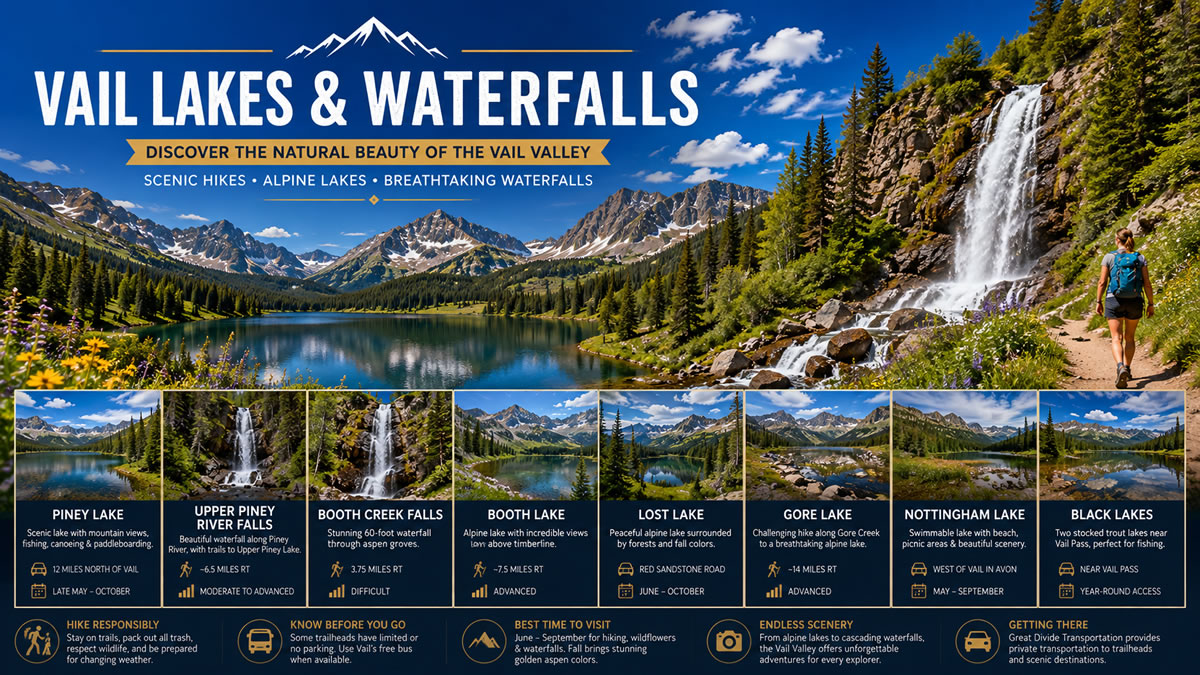
The best-known destinations include Piney Lake and Upper Piney River Falls, Booth Creek Falls and Booth Lake, Lost Lake, Gore Lake, Black Lakes, and Nottingham Lake, each offering a different experience. Some are ideal for photography, fishing, picnicking, or simply enjoying the mountain scenery, while others require significant elevation gain and preparation. The Town of Vail also maintains more than 15 miles of paved recreation paths and numerous hiking and mountain-biking connections, making it possible to experience the area’s waterways without committing to a strenuous backcountry hike.
Why Vail’s Lakes and Waterfalls Are Worth Exploring
The natural attractions around Vail are particularly impressive because of the dramatic contrast between water and mountain terrain. Many of the area’s lakes sit beneath towering peaks, while waterfalls emerge from narrow alpine drainages surrounded by aspen groves, spruce forests, granite formations, and open meadows. In early summer, snowmelt can make waterfalls especially powerful, while later in the season the surrounding vegetation becomes one of the highlights of the experience. By September, the aspen forests around several trails begin changing to brilliant shades of gold, creating a completely different visual experience from the green landscape of midsummer.
Another advantage is the variety of experiences available. A visitor who does not want to spend an entire day hiking can enjoy Nottingham Lake or explore the Gore Valley Trail system, while experienced hikers can dedicate most of a day to destinations such as Gore Lake or Booth Lake. Piney Lake provides another interesting alternative because visitors can combine scenic sightseeing with activities such as fishing, canoeing, and stand-up paddleboarding. In other words, you do not have to be an experienced mountaineer to enjoy the lakes and waterfalls around Vail; you simply need to choose an experience appropriate for your time, fitness level, and interests.
Piney Lake: One of the Most Scenic Lakes Near Vail
Piney Lake is one of the most visually impressive destinations within easy reach of Vail, particularly for visitors who want dramatic mountain scenery without committing to an extremely demanding hike. Located roughly 12 miles north of Vail Village, the lake sits beneath the Gore Range and provides a classic Colorado landscape of calm water, mountain peaks, forests, and open alpine terrain. The journey itself is part of the experience because access includes a slower dirt-road drive, but the scenery that awaits at the lake makes the trip worthwhile. Discover Vail identifies Piney Lake as a hub for activities including fishing, canoeing, and stand-up paddleboarding, while Piney River Ranch provides rustic lodging and other recreational opportunities.
Piney Lake is particularly attractive for travelers who want to spend time outdoors without making the entire day about hiking. The shoreline and surrounding landscape provide excellent opportunities for photography and relaxing, while the Gore Range creates a spectacular backdrop that changes throughout the day as clouds, sunlight, and weather move across the peaks. Visitors interested in a longer adventure can continue from the Piney Lake area toward Upper Piney River Falls and eventually Upper Piney Lake, turning a scenic stop into a much more demanding mountain excursion.
Upper Piney River Falls and Upper Piney Lake
For hikers looking for a more immersive experience, the trail toward Upper Piney River Falls follows the Piney River through meadows and aspen groves before reaching the waterfall several miles into the route. The lower portion of the trail is also used for horseback riding, and fishing is available along portions of the Piney River. Discover Vail describes the waterfall as being about three miles into the hike, while the trail continues several additional miles toward Upper Piney Lake and becomes substantially steeper and more demanding near the end.
This makes Upper Piney particularly appealing to visitors who want the feeling of entering deeper into the Rocky Mountains rather than simply visiting a roadside attraction. The landscape gradually changes as the trail moves away from the lower lake, and the combination of running water, mountain meadows, forest, and increasingly rugged terrain creates a strong sense of wilderness. Because the route involves elevation and distance, hikers should allow sufficient time, carry adequate food and water, and be prepared for changing weather. At Vail’s elevation, a trail that appears manageable on paper can feel considerably more demanding than a similar hike at lower altitude.
Booth Creek Falls: A Spectacular Waterfall in East Vail
Booth Creek Falls is one of the most recognizable waterfall hikes near Vail and is particularly impressive during periods of strong snowmelt. The waterfall drops approximately 60 feet through a rugged mountain setting, with the trail passing through aspen groves and higher-elevation vegetation before reaching the falls. Colorado’s official trail resource lists the route at approximately 3.75 miles with about 1,395 feet of elevation gain and rates it as difficult, making this a hike that should not be confused with a casual stroll.
The appeal of Booth Creek Falls comes from the combination of scenery and relatively direct reward. The trail climbs steadily through forest before reaching the waterfall, and several viewpoints allow hikers to appreciate the cascading water from different perspectives. Snowmelt can make portions of the trail and areas near the falls slippery, so hikers should avoid approaching unstable edges or wet rocks simply to obtain a better photograph. The surrounding views toward the Vail Valley and Eagles Nest Wilderness add another dimension to the experience, making the journey as important as the waterfall itself.
Booth Lake: For More Ambitious Hikers
Visitors who want to continue beyond Booth Creek Falls can follow the trail toward Booth Lake, an alpine lake located at approximately 11,500 feet. This extension adds significant elevation and distance, transforming what is already a demanding waterfall hike into a much more strenuous alpine adventure. Discover Vail currently lists Booth Lake as an advanced hike with an ending elevation of approximately 11,480 feet and more than 3,000 feet of elevation gain.
The landscape changes noticeably as the trail climbs. Aspen forests give way to coniferous vegetation, meadows, rocky terrain, and eventually expansive views toward the Gore Range. The lake itself provides a dramatic reward for hikers who are prepared for the additional effort, but this is not a destination to approach casually. High elevation, steep terrain, changing weather, and the cumulative physical demands of the climb mean that hikers should be prepared with appropriate clothing, water, food, navigation, and sufficient time.
Important Booth Falls Access Information
One of the most important things visitors should know before planning Booth Falls or Booth Lake is that there is currently no parking at the Booth Lake Trailhead or in the surrounding neighborhood. Discover Vail specifically recommends using the free East Vail bus from the Vail Transportation Center and getting off at the Booth Falls stop, followed by approximately a quarter-mile walk up Booth Falls Road to the trailhead. Private vehicle drop-off and pickup are allowed only on a limited basis.
This transportation change is important because parking illegally in the neighborhood can result in towing, while overcrowding has created environmental and safety problems around the trailhead. Using the free Vail bus is therefore not simply a convenience; it is part of the current access strategy designed to reduce traffic, protect the surrounding community, and limit impacts on the Eagles Nest Wilderness. Visitors staying in Vail Village or Lionshead can park in the appropriate structures and use the free local transportation system to reach the trail.
Lost Lake: A Quieter Alpine Experience
Lost Lake offers a different kind of mountain experience from the dramatic waterfalls of Booth Creek. Rather than focusing on a powerful cascade, the attraction here is the peaceful atmosphere of an alpine lake surrounded by forest and wilderness. Access is via Red Sandstone Road, and the area is particularly attractive in autumn when the surrounding aspen groves turn brilliant shades of gold. Visitors can enjoy a picnic near the water, while the broader area also supports mountain biking, horseback riding, off-highway vehicle use, camping, and backpacking.
The appeal of Lost Lake lies in its sense of solitude. The surrounding landscape encourages visitors to slow down rather than rush toward a single viewpoint, making it a good choice for photographers, couples, campers, and travelers who simply want to spend time surrounded by Colorado’s mountain scenery. Fall can be especially beautiful because the golden aspens contrast sharply with the darker evergreen forests and mountain terrain.
Gore Lake and Gore Creek
Gore Creek is one of the defining waterways of the Vail Valley, and the Gore Creek Trail provides access to increasingly remote mountain terrain. The trail follows the creek through meadows and aspen groves before transitioning into conifer forests as elevation increases. Discover Vail currently lists Gore Lake at approximately 7 miles one way, with an ending elevation of about 11,390 feet and roughly 2,679 feet of elevation gain, making this an advanced hike rather than a casual afternoon outing.
The attraction is not limited to Gore Lake itself. The creek accompanies much of the route, creating numerous opportunities to see mountain water cascading over rocks and through the valley. Wildflowers, changing vegetation, forest, and increasingly expansive mountain views make the trail particularly rewarding for experienced hikers. Because the trail enters the Eagles Nest Wilderness, visitors should follow wilderness regulations, stay on designated trails, respect wildlife, and pack out everything they bring with them.
Black Lakes Near Vail Pass
Black Lakes provide another option for visitors who want to combine mountain scenery with fishing and a less strenuous outdoor experience. Located near Vail Pass, the pair of lakes is stocked with rainbow trout twice each year and can be incorporated into a broader day of recreation in the area. The nearby Tenmile Canyon National Recreation Trail also provides opportunities for cycling and exploring the surrounding landscape.
The location makes Black Lakes especially interesting for travelers who are already planning to visit Vail Pass or who want to combine multiple outdoor activities in a single day. Rather than requiring a long alpine hike, the area provides opportunities to enjoy water, mountain scenery, fishing, and recreation in a more accessible setting. As always, visitors should check current conditions and regulations before fishing or planning activities in the area.
Nottingham Lake: A More Accessible Option
Nottingham Lake, located west of Vail in Avon, provides one of the more accessible water-based experiences in the Vail Valley. Unlike many alpine lakes that require a significant hike to reach, Nottingham Lake has a designated swimming area and beach, making it a practical option for families and travelers who want to spend time near the water without committing to a strenuous mountain trail. Discover Vail identifies it as one of the few swimmable lakes in the Vail Valley.
This difference makes Nottingham Lake particularly useful when planning a mixed itinerary. A family might spend the morning hiking or sightseeing and then finish the afternoon near the lake, while visitors traveling with people of different fitness levels can enjoy an outdoor setting without requiring everyone to complete a difficult trail. It demonstrates an important characteristic of the Vail Valley: spectacular mountain scenery does not always require an extreme hike.
The Gore Valley Trail and Water Along Vail
Not every visitor needs to leave the central Vail area to experience the region’s waterways. The Town of Vail maintains a recreation path network of more than 15 miles, including the approximately 12-mile Gore Valley Trail. The route passes through open spaces, parks, recreation facilities, and the core village areas, providing an accessible way to experience the valley without committing to a demanding backcountry route.
One particularly pleasant section is the Village Streamwalk, a pedestrian-only route following the north bank of Gore Creek between the Covered Bridge in Vail Village and Ford Park. The route is approximately one-third of a mile and provides an easy opportunity to experience the creek, surrounding vegetation, and mountain atmosphere while remaining close to the village. The path connects naturally with attractions such as the Gerald R. Ford Amphitheater and Betty Ford Alpine Gardens, making it easy to combine a short nature walk with other Vail activities.
When Is the Best Time to See Vail Waterfalls?
Summer and early fall generally provide the best conditions for exploring the lakes and waterfalls around Vail. Discover Vail identifies June through September as the primary season for these attractions, although individual trails and destinations can have different conditions depending on snowpack, weather, elevation, and seasonal access.
Early summer can be particularly impressive for waterfalls because melting snow feeds streams and increases water flow. The trade-off is that higher trails can still have snow or muddy sections, particularly at elevations above 10,000 feet. By late summer, trails are often more accessible, while September brings the possibility of spectacular fall foliage. The ideal timing therefore depends on whether your priority is maximum waterfall flow, easier hiking conditions, wildflowers, or autumn colors.
Fall Colors Around Vail’s Lakes and Waterfalls
Autumn is one of the most beautiful times to explore the Vail Valley because the aspen forests surrounding many of these trails transform into brilliant shades of yellow and gold. Areas such as Lost Lake and the Piney River corridor are particularly attractive during the fall because the foliage creates a striking contrast against evergreen forests, rocky peaks, and clear mountain water. The combination of fall color and alpine scenery makes this season particularly popular with photographers and visitors looking for a quieter alternative to the busiest summer period.
However, fall weather at elevation can change quickly. A sunny afternoon does not guarantee stable conditions throughout the day, particularly on longer trails. Hikers should be prepared for colder temperatures, shorter daylight hours, and the possibility of early-season snow at higher elevations. Starting early and carrying appropriate layers becomes increasingly important as the season progresses.
Choosing the Right Lake or Waterfall for Your Trip
The best destination depends largely on what you want from the experience. Piney Lake is an excellent choice for dramatic scenery, photography, fishing, paddling, and a relatively relaxed mountain day. Upper Piney River Falls is better for visitors who want a longer hike combined with a waterfall destination. Booth Creek Falls provides a challenging but rewarding waterfall hike, while Booth Lake is suited to experienced hikers prepared for substantial elevation gain. Lost Lake offers a quieter atmosphere and beautiful fall scenery, while Gore Lake provides a demanding wilderness experience for advanced hikers. Nottingham Lake is one of the better choices for families and visitors looking for accessible water recreation.
This variety is one of the strengths of visiting Vail during the summer. You can build an itinerary around your actual interests rather than assuming every outdoor activity needs to involve a strenuous hike. A couple might choose Piney Lake for scenery and a relaxed afternoon, an experienced hiker might dedicate an entire day to Gore Lake, and a family could combine the Vail recreation paths with Nottingham Lake. There is no single “best” lake or waterfall; there is simply a destination that fits the experience you want.
Hiking Responsibly Around Vail’s Lakes and Waterfalls
The beauty of these destinations also makes responsible recreation particularly important. Many trails enter sensitive mountain ecosystems and wilderness areas where vegetation grows slowly and wildlife depends on undisturbed habitat. Visitors should remain on designated trails, pack out all trash, avoid approaching wildlife, and keep dogs leashed where regulations require it. Discover Vail specifically emphasizes staying on trails, packing out waste, respecting wildlife, and planning ahead as part of its Leave No Trace guidance.
Waterfalls and alpine lakes can also create their own hazards. Wet rocks near cascades may be slippery, and the edges of lakes or waterfalls can become unstable. Strong water flow during snowmelt can make apparently accessible areas dangerous. The goal should be to enjoy the scenery without taking unnecessary risks for photographs or closer access to the water. A beautiful landscape will still be there from a safe viewpoint.
Transportation to Vail’s Lakes and Waterfalls
Transportation becomes an important consideration when exploring destinations beyond Vail Village because trailheads are distributed throughout East Vail, West Vail, Red Sandstone, Vail Pass, Avon, and other areas of the valley. Some locations are accessible through Vail’s free bus network, while others require a vehicle and may involve dirt roads or limited parking. The Town of Vail specifically encourages visitors to use public transportation whenever possible, and current trail information directs hikers toward the free bus for popular routes such as Booth Lake and Gore Creek because parking at the trailheads is limited or unavailable.
For travelers staying in hotels or vacation rentals, understanding the transportation situation before leaving is essential. A trailhead that appears close to Vail on a map may have very limited parking, seasonal restrictions, or a specific access procedure. Planning transportation in advance can prevent unnecessary delays and help protect the neighborhoods and natural areas surrounding the trails.
Private Transportation for Exploring the Vail Valley
For destinations that are not conveniently served by the local bus system, private transportation can provide a practical alternative. Great Divide Transportation offers private transportation throughout the Vail Valley, allowing visitors to travel from their hotel in Vail Village, Lionshead, Beaver Creek, Avon, or another nearby destination to selected outdoor attractions without having to navigate unfamiliar mountain roads themselves.
Private transportation can be particularly useful for families, couples, small groups, and travelers carrying hiking equipment, picnic supplies, photography gear, or other outdoor equipment. It also allows visitors to build a more flexible itinerary, combining several destinations during the same day instead of organizing the entire schedule around public transportation. For longer excursions such as Piney Lake, where road conditions and access are important considerations, arranging transportation in advance can make the experience considerably easier.
Getting to Vail from Denver International Airport
For visitors flying into Colorado, the adventure often begins at Denver International Airport. Vail is located west of Denver along Interstate 70, and the drive through the Rocky Mountains is itself an impressive introduction to the landscape. However, mountain transportation requires more planning than an ordinary airport transfer, particularly during periods of heavy summer traffic, winter snow, or major holiday travel.
Arranging private transportation from Denver International Airport to Vail allows travelers to begin their vacation without renting a vehicle or navigating mountain roads after a long flight. Once in Vail, the local transportation system and private transportation options can then be used to reach the individual lakes, waterfalls, trailheads, and recreation areas included in the itinerary.
Exploring Vail’s Natural Side
The lakes and waterfalls around Vail reveal a side of Colorado that is easy to overlook when a trip is centered around skiing, restaurants, luxury accommodations, and the pedestrian streets of Vail Village. In summer and fall, the same mountains that attract skiers become a network of hiking trails, alpine lakes, mountain streams, wildflower meadows, and cascading waterfalls. The landscape becomes quieter and greener, and visitors have the opportunity to experience the Rocky Mountains at a much slower pace.
Whether you choose an accessible destination such as Nottingham Lake, spend an afternoon at Piney Lake, hike to Booth Creek Falls, or commit an entire day to a demanding alpine destination such as Gore Lake, the important thing is to choose an experience that matches your ability and preparation. Vail’s natural attractions reward visitors who take the time to explore them, but they also demand respect for elevation, weather, wildlife, terrain, and wilderness regulations.
Plan Your Vail Outdoor Adventure with Great Divide Transportation
Vail is much more than a winter ski destination. Once the snow melts, the valley opens into a spectacular landscape of alpine lakes, waterfalls, forests, rivers, wildflowers, and mountain trails. Destinations such as Piney Lake, Upper Piney River Falls, Booth Creek Falls, Booth Lake, Lost Lake, Gore Lake, Black Lakes, and Nottingham Lake offer completely different ways to experience Colorado, allowing visitors to choose between relaxed sightseeing and demanding wilderness adventures.
Great Divide Transportation can help make the journey between your Vail accommodation and the surrounding outdoor destinations more comfortable and convenient. Whether you are arriving from Denver International Airport, traveling between Vail and Beaver Creek, or arranging transportation for a day exploring the area’s lakes and waterfalls, a private vehicle allows you to spend more time experiencing the Rocky Mountains and less time worrying about parking, unfamiliar roads, or transportation logistics.
For travelers visiting Vail during the summer or fall, these natural destinations are an opportunity to see a completely different side of the resort. The ski slopes may be quiet, but the mountains are very much alive—with rushing waterfalls, clear alpine lakes, golden aspens, wildflowers, and miles of trails waiting to be explored.
Vail Transportation Service ✈︎
Vail, Beaver Creek, Aspen, Snowmass Limo Services
Premium Vail Limo Services
Our Vail Limo services provide luxury transportation to and from top destinations such as Vail, Beaver Creek, and Aspen Snowmass, with convenient access to major airports including Denver Airport (DEN), Eagle Vail Airport (EGE), Vail Valley Jet Center (EGE), Aspen Airport, Rifle Garfield County Airport (KRIL), and other regional airports.
In addition to airport transfers, we offer private car and limo services for conferences, special events, weddings, and other special occasions. Whether you’re exploring Vail, Beaver Creek, Aspen, or Summit County for business or leisure, our professional transportation services are here to make your Colorado adventures seamless and memorable.