Vail, Colorado, is renowned for its pristine slopes and luxurious ski resorts, but for those seeking an unparalleled adventure, snowcat skiing offers an extraordinary experience. The thrill of carving through untouched powder, deep in the backcountry, promises an unforgettable skiing journey. Below, we delve into every aspect of snowcat skiing, providing the ultimate guide for adventurers looking to maximize their trip.
An In-Depth Guide to Backcountry Powder Adventures
Vail is famous for its enormous ski area, perfectly maintained trails, legendary Back Bowls, and sophisticated mountain-village atmosphere, but there is another side of the destination that appeals to experienced skiers and snowboarders looking for something considerably more remote. Beyond the groomed runs and chairlifts of the resort lies the world of guided backcountry skiing, where a snowcat can transport a small group into terrain that cannot be reached by conventional ski lifts. Instead of spending the day following marked trails and waiting in lift lines, snowcat skiing provides an opportunity to travel into a quieter winter landscape, climb above the trees, and descend through natural powder terrain with experienced guides managing the route and evaluating conditions. Around Vail, this experience is closely associated with Vail Powder Guides, a small, independently operated outfitter permitted to operate in the Vail Pass Winter Recreation Area.
For travelers considering this experience, however, it is important to understand that snowcat skiing is not simply a more luxurious version of resort skiing. It is a guided backcountry adventure that demands stronger skiing or snowboarding ability, physical endurance, preparation, and respect for changing mountain conditions. The reward is a very different relationship with the Colorado Rockies: fewer people, deeper snow, natural terrain, expansive views, and the feeling of earning each descent rather than simply riding a lift to the top. If you are already comfortable skiing challenging terrain at Colorado resorts and want to experience the mountains beyond conventional resort boundaries, snowcat skiing near Vail can become one of the most memorable days of an entire winter vacation.
What Is Snowcat Skiing?
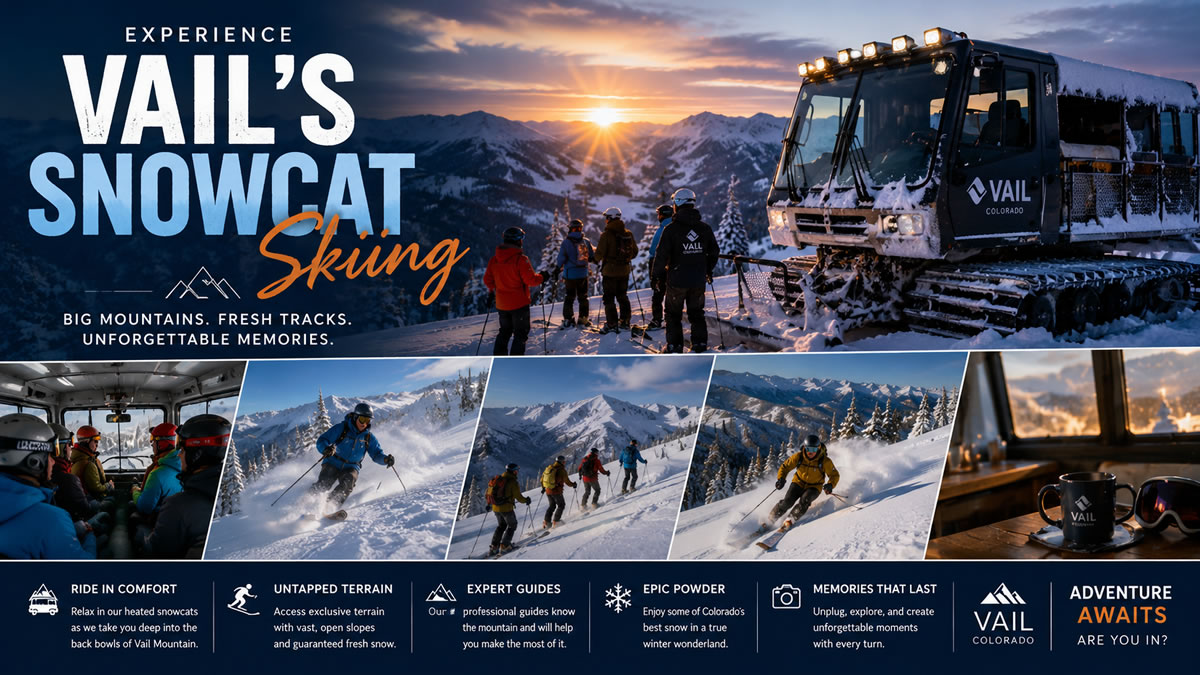
Snowcat skiing uses a tracked, enclosed mountain vehicle—commonly called a snowcat—to transport skiers and snowboarders into backcountry terrain. Rather than relying on a chairlift, gondola, or helicopter, guests ride inside the snowcat while an experienced guide and driver navigate winter roads and access routes toward selected drop-off points. Once the group reaches the appropriate terrain, participants exit the vehicle, prepare their equipment, and ski or snowboard down a natural backcountry descent. The snowcat then relocates the group for another run, allowing participants to repeat the process throughout the day. This creates an entirely different rhythm from resort skiing because the experience revolves around powder runs, terrain selection, snow conditions, and efficient movement rather than lift queues and marked trails.
The snowcat itself is only part of the experience. The real attraction is the terrain it makes accessible. Around Vail Pass, guided operations can reach open bowls, glades, and steeper tree terrain, including areas above timberline where the views become extraordinarily expansive. Vail Powder Guides currently describes its terrain as approximately 3,500 acres and reports that many of its drop-offs are around 12,000 feet, creating panoramic views on clear days. That combination of elevation, natural snow, and remote terrain creates a skiing experience that feels dramatically different from spending another day on the groomed slopes of a major ski resort.
How Is Snowcat Skiing Different From Resort Skiing?
The difference becomes obvious almost immediately. At a conventional ski resort, the infrastructure determines much of your day: you follow designated trails, use lifts to gain elevation, and generally ski terrain that has been managed and monitored by the resort. Backcountry snowcat skiing removes much of that infrastructure and replaces it with a smaller guided operation where the mountain itself determines the experience. Snow conditions can change from one run to another, terrain is not groomed into predictable corridors, and the guide must continuously evaluate weather, snow stability, visibility, wind, and the ability of the group.
This does not necessarily mean that every snowcat run is an extreme descent. Backcountry terrain can include open powder fields, bowls, glades, and tree skiing with different degrees of steepness and technical difficulty. The important distinction is that the terrain is natural and the experience is guided rather than resort-managed. Vail Powder Guides specifically states that its terrain requires strong intermediate to expert skiing ability and advanced to expert snowboarding ability, making honest self-assessment an important part of deciding whether this is the right activity for you.
Where Does Snowcat Skiing Near Vail Take Place?
One important distinction for visitors is that snowcat skiing should not be confused with skiing the lift-served terrain at Vail Mountain. The primary guided snowcat operation associated with the area, Vail Powder Guides, operates in the Vail Pass Winter Recreation Area under a U.S. Forest Service priority-use permit administered through the White River National Forest. The company is independently operated and separate from the nearby ski resorts.
The meeting point is at the Vail Pass Rest Area off Interstate 70, at Exit 190, rather than directly in Vail Village. That distinction matters when planning transportation. Vail Powder Guides indicates that guests meet in the recreational parking area at Vail Pass and should arrive by approximately 8:30 a.m. before the snowcat departs. The location is conveniently positioned between the Vail and Copper Mountain areas, but it is not a destination that visitors should assume they can reach simply by walking from a Vail hotel.
What Is a Typical Snowcat Skiing Day Like?
A snowcat skiing day begins considerably earlier and more deliberately than an ordinary day at the resort. Guests arrive already prepared for the mountain, wearing appropriate layers and ski equipment, and meet their guides before boarding the vehicle. The group then travels toward the day’s selected terrain while the guides evaluate the snowpack and conditions. According to Vail Powder Guides, the snowcat typically departs no later than around 9:00 a.m., with the first run often beginning before 10:00 a.m. This early start is intentional because the goal is to maximize the amount of actual powder skiing rather than spending most of the day traveling between locations.
The amount of skiing can be substantial. Vail Powder Guides reports that guests can often complete 10 to 12 powder runs during a six- to eight-hour day, with individual descents averaging around 1,000 vertical feet and potentially reaching approximately 1,200 feet during stronger snow years. The exact number of runs is never guaranteed because backcountry skiing is inherently dependent on weather, snow conditions, terrain selection, and group dynamics, but the structure of the day is designed around maximizing time on snow.
What Does the Snowcat Experience Feel Like?
Riding inside a snowcat is part of what makes the experience distinctive. Instead of standing in a lift line or sitting exposed on a chairlift, guests travel through a winter landscape inside a tracked vehicle while the guides determine the next destination. The ride provides a chance to rest between runs, discuss conditions, adjust equipment, and prepare mentally for the next descent. Depending on the terrain and weather, the journey can also provide spectacular views of the surrounding mountains and forests.
Once the snowcat reaches a drop-off point, the atmosphere changes completely. You step out into a much quieter environment where there may be no lift towers, crowds, groomed pistes, or resort buildings in sight. Above timberline, the scale of the landscape becomes especially dramatic, with broad views across the surrounding peaks and valleys. On a clear day, this can be one of the most memorable parts of the experience even before the skiing begins. Vail Powder Guides notes that many of its drop-offs are above timberline at roughly 12,000 feet, creating expansive panoramic views in favorable weather.
What Kind of Terrain Can You Expect?
Snowcat skiing is attractive partly because the terrain is considerably more varied than a typical groomed resort run. Depending on conditions and the day’s plan, terrain can include open bowls, powder fields, glades, and tighter tree skiing. The snowcat allows guides to select terrain based on current snow conditions rather than forcing the group to follow a predetermined lift-accessed route. This flexibility can make every trip feel different, even for skiers who have previously visited the area.
At the same time, natural terrain requires a different approach. Powder can be deep and physically demanding, trees can create narrower lines, and visibility can change rapidly at high elevation. A skier who is comfortable cruising groomed intermediate trails may discover that deep powder requires different technique and significantly more effort. This is why Vail Powder Guides emphasizes strong intermediate or expert ability rather than simply using resort trail ratings as a measure of readiness.
Who Should Try Snowcat Skiing in Vail?
Snowcat skiing is best suited to experienced skiers and snowboarders who already have confidence in variable snow and off-piste terrain. You do not necessarily need to be a professional or elite athlete, but you should be comfortable maintaining control in deep snow, adapting to changing terrain, and skiing for several hours at altitude. For snowboarders, the technical requirements can be even more specific because certain traverses and narrow runouts may require strong edge control and the ability to maintain momentum through variable terrain.
The most important consideration is not how aggressively you ski on groomed runs, but how comfortably you can handle terrain when conditions are unpredictable. If you regularly ski challenging terrain at major Colorado resorts and are comfortable skiing powder, trees, and ungroomed terrain, a guided snowcat day may be an excellent next step. If you are still developing your confidence off-piste, however, it may be better to spend more time building those skills within controlled resort terrain before attempting a full backcountry experience.
Is Snowcat Skiing Safe?
No backcountry skiing experience can be described as completely risk-free, and that distinction is important. Unlike controlled resort terrain, the backcountry environment can involve avalanche hazards, rapidly changing weather, deep snow, hidden obstacles, tree wells, difficult visibility, and other natural risks. The purpose of a professional guided operation is not to eliminate those risks but to manage them through experienced decision-making, route selection, group management, equipment, and training.
Vail Powder Guides states that its guides have at least Level 2 avalanche training as well as professional medical or wilderness first-response backgrounds, and avalanche transceivers are provided and required for participants. This is one of the reasons choosing an established guided operation matters. Guests should listen carefully to the guides, understand the safety procedures, stay with the group, and communicate honestly about their ability and physical condition throughout the day.
Avalanche Awareness in the Vail Backcountry
Avalanche awareness is an essential part of understanding snowcat skiing. Fresh powder is precisely what makes the experience attractive, but a new layer of snow can also interact with existing layers in the snowpack in complex ways. Wind, temperature changes, previous storms, sun exposure, and terrain shape can all influence stability. Professional guides therefore evaluate conditions continuously rather than assuming that a slope is safe simply because it looks untouched and beautiful.
This is another major difference between a snowcat experience and ordinary resort skiing. A resort has extensive infrastructure and avalanche-management systems designed around its operating terrain, while guided backcountry skiing takes place in a natural environment where conditions must be assessed much more dynamically. Guests should therefore view the guide’s decisions as an essential part of the experience, including decisions to change terrain, reduce exposure, or even cancel a trip when conditions are unsuitable.
What Equipment Do You Need?
Proper equipment can make an enormous difference in deep snow. Powder-specific skis or snowboards provide greater surface area and help keep the equipment floating rather than sinking into soft snow. Vail Powder Guides offers complimentary use of powder-specific skis and snowboards upon request, which can be particularly useful for travelers who normally ski primarily on groomed terrain and do not want to purchase or transport specialized powder equipment.
Participants should still arrive prepared for a full day in a high-altitude winter environment. Waterproof outer layers, insulating clothing, gloves, goggles, sunscreen, appropriate footwear, and protection from wind and intense mountain sun are essential. Vail Powder Guides specifically advises guests to dress in multiple warm and weather-resistant layers because conditions can shift between intense sunshine, strong winds, low visibility, deep snow, and very cold temperatures during a single day.
How Physically Demanding Is Snowcat Skiing?
The physical demands of snowcat skiing are easy to underestimate because the snowcat eliminates the need to climb the mountain yourself. However, once you begin skiing deep powder repeatedly, the experience can become considerably more demanding than a normal resort day. Powder requires more effort from the legs and core, and making multiple runs at high elevation can quickly accumulate fatigue. The fact that the snowcat provides efficient access to the terrain means you may actually ski more vertical feet in a day than you would on a conventional trip.
For that reason, fitness matters almost as much as technical ability. You should be prepared for several hours of skiing with limited downtime and enough endurance to remain technically sound as the day progresses. Fatigue can affect balance, reaction time, and decision-making, which makes pacing important even for highly experienced skiers.
What Is Included in a Snowcat Skiing Trip?
The exact inclusions depend on the operator and reservation, but a guided day with Vail Powder Guides currently includes guided backcountry powder skiing, use of powder-specific skis or snowboards upon request, and lunch in a backcountry yurt. The company describes its lunch as soup and sandwiches, with snacks and cookies also available, and says dietary restrictions can be accommodated when communicated in advance.
The value of the experience therefore comes from much more than simply getting a ride uphill. Guests are paying for access to permitted backcountry terrain, experienced guides, transportation within the operating area, route selection, safety management, and a full day structured around powder skiing. Because the group is intentionally kept relatively small, the operation can remain more flexible and spend more time skiing rather than managing large crowds.
How Many People Are in a Snowcat?
Small groups are an important part of the experience. Vail Powder Guides currently operates a single snowcat and emphasizes smaller, intact groups because they allow greater mobility throughout the terrain and more efficient powder skiing. Its published rates describe full-day buyouts for groups of up to eight people, with limited mixed-group options also available on selected dates.
For friends or families who ski at a similar level, a private buyout can therefore create a particularly appealing experience. The group can travel together, share the same guide team, and enjoy a day that feels considerably more personal than a conventional resort excursion. It is also a compelling option for corporate groups or special celebrations where the goal is to create an unusual mountain experience rather than simply book another day on the slopes.
When Is the Best Time for Snowcat Skiing in Vail?
Snowcat skiing depends entirely on snow conditions, so there is no single date that guarantees perfect powder. Vail Powder Guides currently indicates that its operations typically begin in early January and continue through early April depending on conditions, while Discover Vail describes the broader snowcat skiing season as approximately December through April.
January and February are often attractive to powder-focused travelers because the winter snowpack is developing and storms can produce excellent conditions. March can also be exceptional, particularly when fresh snowfall combines with longer daylight hours and more comfortable temperatures. April can offer spectacular spring conditions in the right year, but the quality and availability of terrain become increasingly dependent on the season’s snowpack and weather. The best approach is therefore to plan within the operating window while remaining flexible enough to respect actual mountain conditions.
Snowcat Skiing vs. Heli-Skiing
Travelers comparing advanced mountain experiences often wonder whether they should choose snowcat skiing or heli-skiing. Both provide access to terrain that cannot be reached through conventional resort lifts, but the experiences are fundamentally different. Heli-skiing uses helicopters to access much more remote terrain and can involve enormous vertical descents, while snowcat skiing uses ground transportation and typically operates within a defined permitted area.
For many skiers, snowcat skiing represents a more accessible introduction to guided backcountry powder because the operation does not depend on helicopter flights and generally offers a different cost structure. It also creates a slower, more immersive experience in which the ride through the winter landscape becomes part of the adventure. Heli-skiing can provide greater geographic range and more remote terrain, but snowcat skiing offers its own unique combination of accessibility, intimacy, and repeated powder runs.
Snowcat Skiing vs. a Day at Vail Mountain
A day at Vail Mountain and a day of snowcat skiing should not be viewed as competing versions of the same activity. They are fundamentally different experiences. Vail Mountain provides a massive lift-served resort with groomed runs, ski patrol, restaurants, lifts, gondolas, lessons, and terrain suitable for a wide range of abilities. Snowcat skiing is much smaller, more specialized, and focused on experienced skiers who want natural terrain and guided backcountry access.
For a first-time visitor to Vail, spending several days at the resort before attempting snowcat skiing can be an excellent strategy. You can explore Vail’s Frontside, Back Bowls, and Blue Sky Basin while becoming familiar with the altitude and local snow conditions. If you already have significant experience in Colorado and want to dedicate one day to something more adventurous, snowcat skiing can provide a dramatic contrast to the resort experience.
How Much Does Snowcat Skiing Cost?
Snowcat skiing is a premium mountain experience, and the price reflects the specialized operation, limited group size, professional guiding, permitted terrain, equipment options, and full-day nature of the experience. It should not be compared directly with the cost of a normal lift ticket because you are purchasing access to a guided backcountry operation rather than simply transportation uphill.
Published rates from Vail Powder Guides have listed $950 per person and $7,600 for a full snowcat buyout for up to eight people for the season referenced on its rates page, with deposits and cancellation policies applying to reservations. Because pricing can change by season and availability, travelers should confirm the current rate directly with the operator before booking.
Where Do You Meet for Snowcat Skiing?
One of the most important logistical details is the meeting location. Vail Powder Guides meets guests at the Vail Pass Rest Area near Interstate 70 Exit 190, rather than at Vail Village or one of Vail Mountain’s gondolas. Guests are asked to arrive by approximately 8:30 a.m. and be fully prepared before boarding the snowcat.
This is especially important for travelers staying in Vail, Beaver Creek, Breckenridge, or another nearby mountain community. The drive to the meeting point needs to be planned around winter road conditions, traffic, weather, and the required arrival time. A late arrival can jeopardize the entire experience because the snowcat is operating according to a carefully structured schedule.
Transportation to Vail Pass for Snowcat Skiing
Transportation deserves special attention because the snowcat experience begins outside the central Vail resort. Vail Powder Guides does not provide its own transportation to Vail Pass, although the company indicates that it can assist guests with arranging rides and specifically recommends local transportation options for smaller groups and private transportation for larger buyouts.
For travelers staying in Vail Village, Lionshead, Beaver Creek, or another resort community, arranging a private vehicle can be one of the simplest ways to eliminate uncertainty on the morning of the trip. Winter mountain roads can be affected by snow, ice, traffic, and changing conditions, and arriving at the meeting point on time is critical. A dedicated vehicle also means guests can travel with skis, snowboards, boots, clothing, and other equipment without worrying about fitting everything into a standard rideshare vehicle.
Private Transportation from Vail to Vail Pass
Great Divide Transportation provides private transportation throughout Colorado and can be a practical option for travelers who need transportation between their Vail-area accommodation and the Vail Pass meeting point. For guests staying in Vail Village, Lionshead, Beaver Creek, or surrounding communities, prearranging transportation allows the morning to begin according to the snowcat operator’s schedule rather than relying on last-minute transportation availability.
This is particularly valuable for groups traveling together. Skiers can keep their equipment organized, travel together, and arrive at the Vail Pass Rest Area with enough time to prepare before departure. After a full day of powder skiing, the same private transportation can return the group to Vail or another destination without requiring anyone to drive after several hours of demanding skiing at high altitude.
Is Snowcat Skiing Worth It?
For the right skier, snowcat skiing can absolutely be worth the investment. The experience is not about checking another activity off a Vail itinerary; it is about accessing a completely different side of the Rocky Mountains. Instead of spending another day on familiar resort runs, you are entering a guided backcountry environment where the terrain is natural, the group is small, and the focus is on fresh snow and quality descents.
The value becomes even clearer for experienced skiers who have already explored Vail’s conventional terrain. After skiing the resort’s groomed trails, Back Bowls, and other lift-accessed areas, a snowcat day provides a sense of progression into a different style of mountain skiing. The combination of high-elevation views, untouched snow, natural terrain, professional guiding, and a full day away from resort crowds can create a memorable highlight of a Colorado winter vacation.
Plan Your Vail Snowcat Skiing Adventure
Snowcat skiing represents the adventurous side of Vail that many visitors never experience. While the resort is famous for luxury hotels, excellent restaurants, extensive ski terrain, and the atmosphere of Vail Village, the surrounding mountains offer opportunities to go much deeper into the winter landscape. A guided snowcat trip provides a bridge between resort skiing and the backcountry, giving experienced skiers and snowboarders access to remote powder terrain without requiring them to organize an entirely independent expedition.
The key is preparation. Choose an operator with experienced guides, be honest about your skiing ability, understand the risks associated with backcountry terrain, prepare for high-altitude weather, and organize transportation to the meeting point before the morning of your trip. When all of those details are handled properly, the day becomes less about logistics and more about what you came to Colorado to experience: deep snow, dramatic mountains, and the freedom of skiing through terrain far removed from the crowds.
Experience Vail Beyond the Resort
Vail snowcat skiing offers a rare opportunity to experience Colorado from a perspective that most visitors never see. Above the trees, surrounded by open bowls, forested slopes, expansive ridgelines, and enormous Rocky Mountain views, the experience feels fundamentally different from ordinary resort skiing. The snowcat is simply the vehicle that makes that experience possible; the real attraction is the terrain, the snow, and the feeling of moving through a wild winter landscape with a knowledgeable guide leading the way.
If you are staying in Vail or Beaver Creek and have booked a snowcat adventure at Vail Pass, Great Divide Transportation can help make the transportation portion of the experience easier by providing private transportation to and from the meeting area. After all, when you are preparing for a full day of powder skiing, the last thing you want to worry about is winter driving, parking, equipment space, or whether you will arrive at the trailhead on time. Organize the transportation in advance, focus on the mountain, and let your snowcat adventure become one of the defining experiences of your Vail winter vacation.
Private Cars & SUVs from Colorado Airports to Vail
Luxury Airport Transportation from Denver International Airport to Vail
Travel from the airport to Vail in comfort with a private car or SUV designed for Colorado mountain travel. Our private airport transportation to Vail provides direct, door-to-door service from Denver International Airport (DEN) or Eagle County Regional Airport (EGE) to Vail Village, Lionshead, West Vail, East Vail, and surrounding resort accommodations.
Whether you are traveling as a couple, with your family, or with a group carrying ski and snowboard equipment, our private vehicles provide a comfortable alternative to shared airport shuttles and rental cars. Your professional driver handles the mountain roads while you relax after your flight and enjoy the scenery along the way.
Private Airport Transfers to Vail, Colorado
Our private cars and SUVs are available for travelers arriving at Denver International Airport, the primary gateway for visitors coming from across the United States and internationally, as well as Eagle County Regional Airport, which offers a significantly shorter transfer to Vail. We provide direct transportation from the airport to your hotel, private residence, vacation rental, or other destination in the Vail Valley.
During the winter season, professional transportation becomes particularly valuable because Colorado mountain travel can involve snow, changing weather, traffic, and difficult road conditions. Instead of renting a vehicle and navigating unfamiliar mountain roads after a long flight, you can arrange your private airport transfer in advance and travel directly to Vail with a driver familiar with the route.
Comfortable Transportation for Your Vail Vacation
Our private cars and SUVs are ideal for travelers who want their vacation to begin the moment they leave the airport. There are no shared passengers or unnecessary stops along the way. Your vehicle is reserved for your party, giving you the flexibility and privacy needed for a comfortable journey from the airport to Vail.
Vail transportation
For winter travelers, we can also accommodate the additional luggage associated with a mountain vacation, including skis, snowboards, boots, and other equipment, depending on the vehicle selected. Whether you are heading directly to Vail Village for a ski vacation or continuing to Beaver Creek, Avon, or another Colorado mountain destination, private transportation provides a convenient and dependable way to begin your trip.